Here is Winston, about nine weeks old. Winston has been with us for nearly two weeks. Earlier this week, he and his sister Maggie (yes, named after two British prime ministers) chewed on a Sego palm, something extremely toxic for all dogs. We took them to the veterinarian, where they began two days of treatment. Initially, the bloodwork was good, but the vet kept them overnight to watch them. The next morning Winston’s liver enzyme levels had skyrocketed and we were fearing for his life. Both my wife and I spontaneously fasted and prayed, without telling each other. The spiritual discipline of fasting is ancient and trustworthy, and perhaps can help develop a greater hunger for something more profound. Perhaps the giving up of food or drink can awaken a hunger for a deeper and more meaningful life, can develop a hunger for God.
Those of us who are alcoholics, or addicts of another sort, are fasting today, if we are working our program. I am fasting from alcohol today, and have been for more than 33 years. God willing, I will continue the fast the rest of today and begin again tomorrow. Giving up alcohol and other drugs has opened my life up in profound ways, most importantly in my search for God. I no longer look for the God of my understanding, as is mentioned in the 12 Steps, but I seek and am found by the God completely beyond my understanding, the God of grace that forgives my sin and faithlessness not because of what I’ve done but because of who Jesus is.
The next day we called the vet and found out that Winston’s levels were now normal, with no explanation. Folks joined us in prayer all over the world. Winston and Maggie are back home with us, living testimony to the power of prayer and the gifts of God’s mercy.
Did fasting make the difference? I don’t know. I don’t know a lot about how God works.
A vulture waiting on a rooftop during a recent walk….
I have a friend who has a lovely wife and a young child. The child is growing up away from his father because his father is in prison. He is separated from his family and in prison because he chose death instead of life, he chose the demon spirits in bourbon rather the the Holy Spirit, and because he continually believed he was stronger than he was, that he was more powerful than he was, that he was smarter than he was…he believed, whether he acknowledged it or not. And when I hear from him, it is like there is this sense of nobility, that he is on some sort of holy quest. Most of us alcoholics or other addicts can relate to this sense of the heroic — Satan, and I believe in Satan, is the Father of Lies, and addicts are so vulnerable to those whisperings in the ear that no one understands our quest, our true self, and we will be vindicated in the end. The Father of Lies.
Alcoholism is primary, progressive, chronic and fatal. If not dealt with as primary, it will end up as fatal — either in actual loss of life or the death of a family, the death of a dream, the legacy of a boy growing up with his father in prison and the secrets around that as he goes to school…I know something about that, and many of you reading this know something about it, too.
But it didn’t have to be that way. And it doesn’t have to be that way for anyone else.
Here is from the first chapter of James:
Let no one say when he is tempted, “I am being tempted by God,” for God cannot be tempted with evil, and he himself tempts no one. But each person is tempted when he is lured and enticed by his own desire. Then desire when it has conceived gives birth to sin, and sin when it is fully grown brings forth death. Do not be deceived, my beloved brothers.
There is no sin in being tempted. Being tempted can be a wake-up call. I am tempted by things my family and friends are not — my own desires. But when I entertain desires that can lead to upheaval, I can give them root. And when rooted and fed and nurtured, they gives way to sin and death. Death of a marriage, death of a relationship, death of a ministry, death of self…
But it does not need to be that way, for those who trust in Christ Jesus. In our baptismal vows we say we believe in the power Christ gives us to “resist evil, injustice, and oppression in whatever forms they present themselves.” We have the power to say no, and not give in. We have the power, but some, like my friend, did not seek out that power. We have to want it!
Look at the vulture, on the housetop waiting.
Be sober-minded, be watchful. Your adversary the devil prowls around like a roaring lion, seeking someone to devour. Resist him, firm in your faith, knowing that the same kinds of suffering are being experienced by your brotherhood throughout the world. And after you have suffered for a little while, the God of all grace, who has called you to his eternal glory in Christ, will himself restore, confirm, strengthen, and establish you. To him be the dominion forever and ever. Amen (1 Peter 5: 8-11)
Here’s a sermon from 2009 about Pentecost, the time the Church remembers the pouring of the Holy Spirit, giving the power to witness. How valid is our witness? Do we witness to the resurrection in our own lives or do we reshape God to fit our ideas? I’m interested in what you might think…Here you go:
Frank Richard Coats
May 31, 2009
Pentecost Year B
Acts 2: 1-21
The Gift of the Spirit
Focus statement: God wants all to be saved
Last Sunday afternoon I went home for a little while, had lunch with Brenda and took a brief nap and then headed down to Houston for the Texas Annual Conference. Somewhere along that long road to Houston along US 59 I passed some sort of business with an enormous Confederate flag flying out front. It was more than two times larger than the flag of the United States of America which flies outside our Welcome Center. And I had a physical reaction: I felt a tightening in my stomach, and my hands gripped the steering wheel a little tighter as I wondered why the person inside would fly such a flag.
When I was a kid, growing up in Houston, I loved the romantic stories of the South. Those of you my age may remember the TV show The Rebel which starred Nick Adams and had a wonderful theme song sung by Johnny Cash. The romantic story of a noble, defeated cause which still held its integrity and gained strength through its brokeness appealed to me. I liked gray better than blue, too, and I liked the stars and bars.
But as I became older and learned more of what brought about the Civil War I wondered why there was such romanticism about a rebellion against the United States. I wondered why the leaders of that rebellion are held in such high esteem. On this past Memorial Day, we saw figures that almost half of all Americans who have died in battle died in the Civil War. Deaths on both sides counted, because Lincoln never acknowledged the South’s right to secede, therefore the Confederacy was never an acknowledged separate nation.
And I would hear the ideas that it was about states’ rights and the seizing of power by the federal government that brought about the rebellion, and it was not about slavery but about keeping the South down and not letting them rule themselves.
But it was about slavery. The states wanted the right to maintain the practice of the buying and selling of a people they regarded as less than human – 3/5 human in our Constitution – and the federal government had no right to say they could not. Almost half of the constitutional delegates in 1787 were slaveowners after all, and they had not seen fit to outlaw slavery. Even Thomas Jefferson, the writer of the Declaration of Independence, owned other people.
All these things were going through my mind as I saw that large, large Confederate flag hanging alongside an American highway. What were they thinking? And I wondered if they believed — as our scripture says — that all who called on the name of the Lord would be saved.
Today’s reading lets us know where God stands – God who created all of us, who loves all of us, who created all of us in the image of God – we are given an example today of the Kingdom of God, moving beyond any ideas of territories or boundaries.
The text opens with “When the day of Pentecost had come, they were all together in the same place.”
Our celebration of Pentecost is from this passage in Acts, but the original celebration was a celebration of the wheat harvest, and was 50 days after Passover. “They” refers to the apostles. The first chapter retold the story of the Ascension of Jesus and then the choosing of Matthias to replace Judas. You remember that Judas Iscariot betrayed Jesus, tried to return the money for the betrayal and killed himself before he could reconcile with the others. His next meeting with Jesus is something we can only imagine…
So they were all in one place. Before Jesus ascended, he told them to wait in Jerusalem until power came upon them from one high. He said, You will receive power when the Holy Spirit comes upon you, and you will be my witnesses in Jerusalem, in all Judea and Samaria, and to the ends of the earth. After he said this, they watched him rise out of sight.
So they went back to Jerusalem, and prayed and praised the Lord. Suddenly from heaven there came a sound like the rush of a violent wind, and it filled the entire house where they were sitting. Divided tongues, as of fire, appeared among them and a tongue rested on each of them. All of them were filled with the Holy Spirit and began to speak in other languages, as the Spirit gave them utterance.
The sound of the violent wind, the manifestation of tongues of fire and the sudden cacophony of voices in lots of languages drew a crowd. More and more gathered as they heard and witnessed this strange sight. And people from all over the world were there in Jerusalem, the pattern moving from east to west. Some place names were “archaic” by the time of the first century, meaning some of the places no longer existed. They all heard the stories of the power of God in their own languages. And the marveled that the men speaking were Galileans, not men of education or culture but …well…just fishermen…
And they heard from all the world, and from the past and now to the future, of the power of God, of the deeds of God.
And the word used here means “languages” and is not the same word used for “ecstatic speech” that Paul uses and that we mean when we talk about people “speaking in tongues”. This means being able to speak in a foreign language not known to the speaker.
So try to picture yourself there. About midmorning there is a sound of a violent wind that goes through a house, through a building, and suddenly these men whom you had seen around the place and perhaps recognized as being some of the followers of Jesus started speaking in these foreign languages. And people around you started turning their heads at the sound. “I hear someone speaking my language”; “They’re talking to me!” “How do these men know this?”
“What’s going on?”
And “is what they are saying about God true?” “Does their God care for me, too?”
Of course there were scoffers, and the text says: All were amazed and perplexed, saying to one another, “What does this mean?” But others sneered and said, “They are filled with new wine.”
Then Peter, who had not long ago denied Jesus in front of a servant girl and two strangers, rose to speak, and made one of the boldest speeches in the book of Acts. Peter, once terrified, had been changed. He was filled with the Holy Spirit, and he gave witness to Jesus.
He said they were not drunk, because it was only nine in the morning. Now of course this doesn’t mean it is not possible to be drunk at nine in the morning! But Peter is defending the character of the others and the power of God. He framed what had happened in the ancient prophecy of Joel, of the things that were to take place in the last days.
I will pour out my Spirit upon all flesh and your sons and your daughters shall prophesy, and your young men shall see visions, and your old men shall dream dreams. Even upon my slaves, both men and women, in those days I will pour out my Spirit; and they shall prophesy. And I will show portents in the heaven above and signs on the earth below, smoke and fire and smoky mist. The sun shall be turned to darkness and the moon to blood, before the coming of the Lord’s great and glorious day. Then everyone who calls on the name of the Lord shall be saved.
To prophesy means to speak the word of the Lord, not necessarily to foretell the future like most of us think of it. Before the Spirit came upon people selectively – there is the story of Saul being struck by the Spirit and prophesying, which seems to be like going in a frenzy. And the birth narratives of Luke talk about people being filled with the spirit: Zechariah, Mary, Simon, John the Baptist and then Jesus.
But now Peter says the gifts and power of God are open to all people, not just the chosen few. Old and young, rich and poor, male and female, slave and free. Through the mighty works of God in Jesus Christ the world is opened, the Holy Spirit, the power of God is poured out upon all the world, crossing all barriers of time and space, making the love and power of God to witness to the power of the resurrection, the power of the forgiveness of God and the strength to change lives, available to all.
Do you think that’s true?
I go back to that large Confederate flag I saw last week. Does that person think God’s love and mercy is available to all? To everyone?
And then there is the question for me: Do I think it is available to him?
Let us pray:
Merciful God, you who open the church to all people of all nations and races, give us the grace to love as you love, to forgive as you forgive, to be as you are as you shape us into your image. May your shape us into your image, and bring to light all our attempts to shape you into ours.
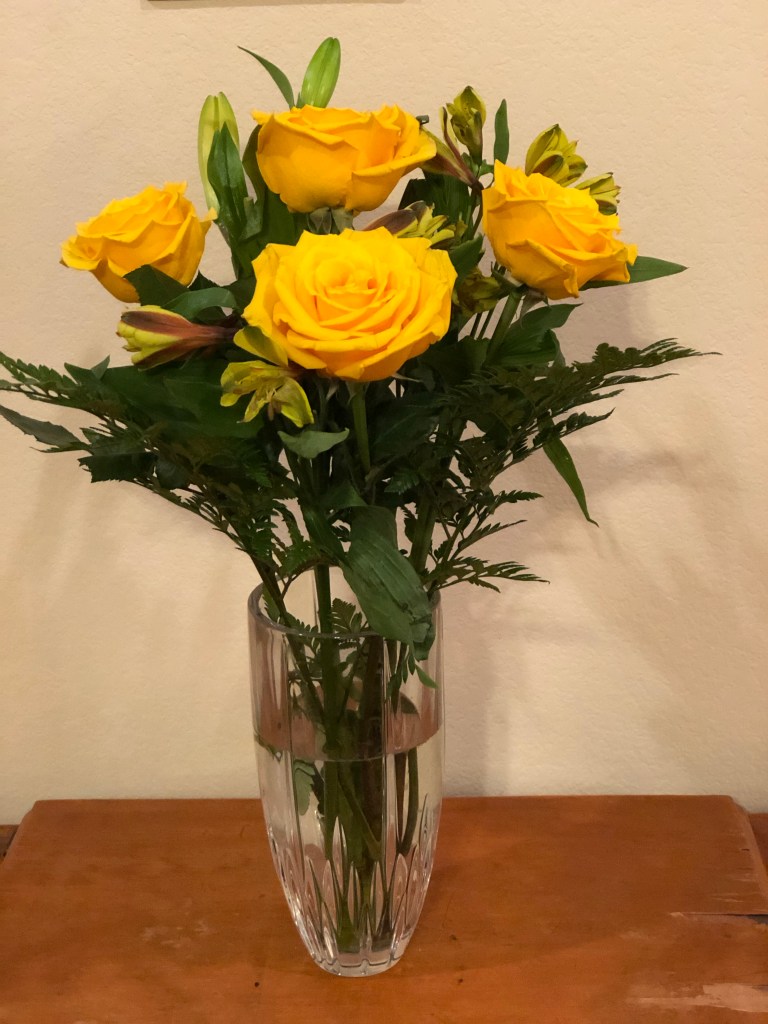
We moved six months ago, and one of the going away gifts from a church member was this beautiful vase. They had been in the military for much of their lives, and a vase like this had been given to them by dear friends. It means a great deal to us, and when we fill it with flowers it’s like like bringing our friends into our home.
We think about making our home a safe place, and making it a place of refuge or retreat. I often think of it like that, a place to get away to, a place to hide away..
Years ago I led a writing workshop at a family retreat, and gave an assignment: spend 10 minutes writing in your notebook on “home”. Keep your hand moving, don’t think about it, just write for 10 minutes. (I got the idea from Natalie Goldberg, in her book Writing Down the Bones.)
Afterward some folks read what they had written and it was a surprisingly healing exercise. One man dealt with some long suppressed grief from his father, and someone else told how just writing on that word — “home” — opened things up for her in surprising ways.
What does home mean to you?
Now I want our home to be a place of fellowship, a place of love and encouragement, a place of hospitality where our neighbors can find a cup of coffee, a place of safety, a place of prayer and blessing. I want the place where we live to be a place where I can show my true home — my life with Jesus Christ.
Since God has so generously let us in on what he is doing, we’re not about to throw up our hands and walk off the job just because we run into occasional hard times. We refuse to wear masks and play games. We don’t maneuver and manipulate behind the scenes. And we don’t twist God’s Word to suit ourselves. Rather, we keep everything we do and say out in the open, the whole truth on display, so that those who want to can see and judge for themselves in the presence of God. (2 Corinthians 4: 1-2, The Message)
Abide means to rest, to remain, to stay. Jesus says in John 15: 7-8, If you abide in me and my words abide in you, ask for whatever you wish, and it will be done for you. My Father is glorified in this, that you bear much fruit and become my disciples.
I still think about mission, evangelism, and the difference between what I’ve been told and taught by some and what I find in scripture. I’m taking a class from the Inspire School of Discipleship — I’m one of the co-leaders, actually — called “Biblical Principles for Missional Discipleship”. Inspire teaches the Biblical and Wesleyan principal that we are called by God to be missionaries in our lives, the lives we have been given, in the families and the neighborhoods where we dwell. We don’t have to go to China or Asia (or California or Oregon!) to be missionaries — we can and are called to be missionaries where we woke up today.
In AA we are to “carry the message” and “practice these principles in all our affairs” as part of working the 12 Steps. We show what we have been given, we tell our stories of sobriety, of redemption, to those who want and need to hear. We lives our lives out loud, without wearing the masks of a false self, without a fake confidence or an assurance that is not real.
As disciples of Jesus we are called to do the same thing; live authentically, share our lives as they are, and as we seek to grow in Christ we share that, too, and therefore we may begin to make disciples WITH Jesus, not just given a task to make disciples FOR Jesus. There’s a difference — can you tell?
Given to me on my first AA birthday back when nearly everybody smoked
The 12th Step of Alcoholics Anonymous is: Having had a spiritual awakening as the result of these steps, we tried to carry this message to alcoholics, and to practice these principles in all our affairs.
I’m going to continue with what comes next in the Big Book, Alcoholics Anonymous:
Many of us exclaimed, “What an order! I can’t go through with it.” Do not be discouraged. No one among us has been able to maintain anything like perfect adherence to these principles. We are not saints. The point is, that we are willing to grow along spiritual lines. The principles we have set down are guides to progress. We claim spiritual progress rather than spiritual perfection.
Our description of the alcoholic, the chapter to the agnostic, and our personal adventures before and after make clear three pertinent ideas:
(a) That we were alcoholic and could not manage our own lives
(b) That probably no human power could have relieved our alcoholism.
(c) that God could and would if He were sought. (from Chapter 5: “How it Works”, page 60)
In this blog and during this time in my life I am pondering the relationship between recovery and discipleship. In AA it is central that the message get carried, that you keep your sobriety by giving to others. When we read the exclamation “What an order!” we know it refers to the arduous path to freedom through the 12 steps: Admitting we need help, being willing to turn to God, turning to God as best we can, admitting our faults to God, to ourselves and to another human being. We become willing to make amends and make amends when possible. We practice rigorous honesty in all affairs, and we carry the message to others.
This is a clear path of discipleship, and we in the Church could learn much.
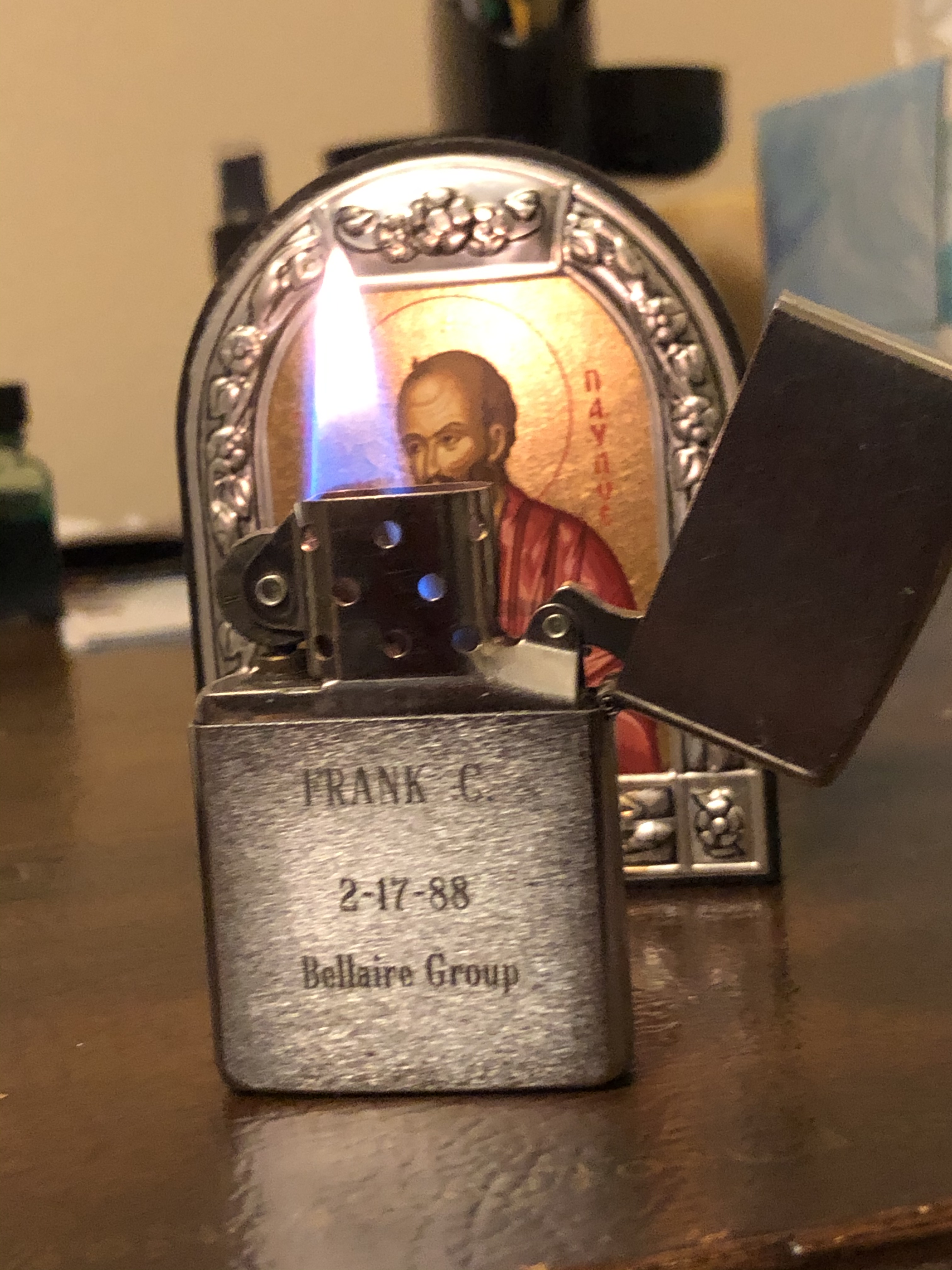
By the way, I doubt my AA friends will be offended by a cigarette lighter.
The back has my name, my sobriety date — 2/17/88 and the name of the Bellaire Club, where my sponsor Jesse gave me this gift.
I’ve been thinking about being a witness the last few days. When Jesus appeared to the disciples after the Resurrection, as told in Luke 24, the Lord “opened their minds to understand the scriptures, and he said to them, “Thus it is written, that the Messiah is to suffer and to rise from the dead on the third day, and that repentance and forgiveness of sins is to be proclaimed in his name to all nations, beginning from Jerusalem. You are witnesses of these things.”
“Witness” now means an onlooker as a noun, and something you see as a verb. I am a witness, and it is because I witnessed something, for instance. The Greek word used in Luke is martyr and the first definition for this word in the Oxford English Dictionary is something different: the specific designation on honour (connoting the highest degree of saintship) for one who voluntarily undergoes the penalty of death for refusing to renounce the Christian faith or any articles of it for perseverance in any Christian virtue; or for obedience to any law or command of the Church.
So for the early Church, and the first followers of Jesus, witness meant more than an outside observer; it meant someone deeply invested in the truth, no matter the cost.
When Jesus told his followers they were witnesses to these things, he told them a fact and issued a challenge. In some ways it would be easier to just go back to fishing. Who would believe them, who would believe what they saw?
If Jesus was raised from the dead, that must mean what he said was true. It must mean we are to love our enemies, we are to love God above all and love our neighbors as response to that love of God. It would mean that nothing else matters, and it would be a truth that they (we) could not deny, no matter the cost. We would be witnesses.
I am a witness; I have seen the Resurrection in my life, and in the lives of others. And I have seen the hatred and the fear and anger of those who oppose this truth, and I hope to proclaim the truth of repentance and forgiveness as long as I live.
Be not deceived; bad company corrupts good morals. Come to your senses (sober up! is an alternate translation) and stop sinning; for some people are ignorant about God. I say this to your shame. I Corinthians 15:33
I called to the Lord in distress, and he answered me with freedom. Psalm 118:5 CSB alternate translation
I’ve been thinking about the company I keep, as well as the company I am. The folks I hung around when I was in school may not have been the best company for me to keep. God works it all out in the end if all is taken to Him, but things could have been much worse for me than they were. I wasn’t caught…
In AA, we are taught we have to change everything about our lives if we want to live a new life, if we want to stay sober. There, much more so than in the churches I am used to, is demanded a life of rigorous honesty. When your life is on the line, you stick to what is important.
We ask a lot of people in Alcoholics Anonymous. The language of the Big Book, at least the first 164 pages, has not been updated since the original publication. Some of the reading can be challenging, but you’ve got to want it; you’ve got to want to change your life. If someone comes to a meeting and says he or she is not sure if it’s for them, we tell them to go out and do some more “field testing”.
The AA program is not on the fence. Folks come in to change their lives, to hopefully restore relationships with family and themselves. It all starts with telling the truth and surrounding yourself with others who will do the same.
The Church can be like that, too. What if we had a “way of life” of discipleship for folks to follow, and mentors to lead the way like the sponsors in AA? What if we had an active path for becoming a disciple and teaching how to make disciples of others?
Keep company with those who want the changed life, if you want the changed life. Be with folks who encourage, uplift, correct, teach, learn. And pay attention to the one whose company can be the most dangerous, that voice you hear in your head and heart that you are not enough, that you can never be…
Too many keep company with that one for too long. I have spent too much time with that voice, and still can find company there. That voice is not from God.
You can get relief by calling out. Once more:
I called to the Lord in distress; he answered me with freedom.
Thou wilt keep him in perfect peace, whose mind is stayed on Thee, because he trusts in Thee. Isaiah 26:3
Tonight is Maundy Thursday, a powerful night of remembrance. I came once more to a belief in God after a Maundy Thursday service, and I’ve tried writing about that several times, but have never been able to capture the moment.
I suppose it’s the story we’ll tell again tonight. Jesus is with his disciples in a borrowed room during the time of Passover, sharing the traditional meal. Jesus knew the time was near for His death. Jesus knew that that Father had given everything into his hands, that he had come from God, and that he was going back to God. So he got up from supper, laid aside his outer clothing, took a towel, and tied it around himself. Next, he poured water into a basin and began to wash his disciples’ feet and to dry them with the towel tied around him. John 13: 3-5
Jesus knew He would be betrayed; this becomes clear later in the passage. He knew it was Judas, son of Simon Iscariot, who would betray Him. Jesus told Judas to do what he was going to do, and to do it quickly.
Jesus washed the feet of the man who would betray Him. Jesus washed the feet of Peter, too, who would deny Him later that night.
In Alcoholics Anonymous, “we are sure God wants us to be happy, joyous and free..” (Alcoholics Anonymous, p. 133). Don’t you want that? I know I want that, to be happy, joyous and free.
Being that free must rest with a trust in God that will surpass any circumstance, a trust in God that surpasses any understanding I have — but I want that understanding; I want that peace, I want that mind stayed on God.
Jesus had a trust that was beyond the circumstances, and faced the coming ordeal by serving those He loved.
Jesus loved Judas, offering him a choice part of the meal before calling him out, washing his feet before then.
Maundy Thursday is a night to remember betrayals, and to remember that we don’t deny them, ignore them, bury them, but we face them and we love through them. We pray for the serenity to accept the things we cannot change, the courage to change the things we can, and the wisdom to know the difference. We pray that our minds may rest in peace, because our minds are stayed on God.










 The Unforced Rhythms of Grace -- Frank Coats