I’m drawn to folks with a strong sense of purpose. Many of the folks I admire are dedicated to their craft, their work, their art. I have been a dabbler all my life, and I’ve got a lot of hobbies but don’t know that I am totally dedicated to any one thing..except Jesus. I can imagine not playing the guitar anymore, though with a great deal of loss, or one of the other instruments I dabble with, but I don’t see life without seeking the Lord.
Luckily, I don’t have to do anything like that. But it doesn’t mean I don’t struggle, don’t worry about being enough, doing enough, being the person I think God wants me to be. I’m alcoholic, and at this writing I’ve been sober for a little more than 33 years. What I’ve learned through the program of Alcoholics Anonymous is a straightforward way of seeking God — no pretense, no BS, but a sheer look up from the floor and crying for help. I’ve been a pastor for nearly 18 years, and a churchman for most of my life, and I’ve seen more honest cries for help more regularly in recovery rooms than anywhere else.
There’s a gift in losing all you have, and finding out what you held on to was worthless. Living a life in truth — “practicing these principles in all our affairs” — leads to the abundant life Jesus talks about in John’s Gospel, or so it seems to me.
Here’s a couple of verses I’ve been thinking about in the last few weeks, and I took the blog title from the second one. Both of these quotes are from Eugene Peterson’s The Message:
I have been crucified with Christ. My ego is no longer central. It is no longer important that I appear righteous before you and have your good opinion, and I am no longer driven to impress God. Christ lives in me. The life you see me living is not “mine”, but it is lived by faith in the Son of God, who loved me and gave himself for me. I am not going to go back on that. Galatians 2:20
This notion of dying to self, and putting it in these terms that “my ego is no longer central” is so eye-opening, isn’t it? I am not going to be so preoccupied with what you are thinking of me, or if you are thinking of me, and I’m not going to keep trying to prove myself to God. I don’t have to — God loves me, and I don’t have to keep trying to prove that to myself or others.
Here’s the second quote, this one from Matthew 11:
Are you tired? Worn out? Burned out on religion? Come to me. Get away with me and you’ll recover your life. I’ll show you how to take a real rest. Walk with me and work with me — watch how I do it. Learn the unforced rhythms of grace. I won’t lay anything heavy or ill-fitting on you. Keep company with me and you’ll learn to live freely and lightly. Matthew 11: 26-30.
I’ve got a lot to learn about writing a blog, and I’ll include some sermons in this as well and perhaps a podcast, but it’s good for all of us to remember that God loves us, and we don’t have to prove it to ourselves, to others, or to God.
We are invited to live into it. Maybe you’d like to walk with me on this journey.
Psalm 80 reached out to me this week, and today I am using it as I fast for two families who have suffered immense loss.
The first family lost a member after a long and complicated hospital stay. He was a son, a husband, a father, a grandfather and a community leader, and it is a powerful loss.
The second has been in the midst of spiritual warfare for months now. They have endured two car wrecks, a dog bite, a broken foot, countless mishaps and then the loss of a pregnancy.
Throughout it all we know God is good, but we know there is pain and grief and anger for these losses.
Here is Psalm 80, from the English Standard Version. Listen to the chorus, pray it for you and for the people you pray for: Restore us, O God. Let your face shine, that we may be saved!
Restore Us, O God
To the choirmaster: according to Lilies. A Testimony. Of Asaph, a Psalm.
1Give ear, O Shepherd of Israel, you who lead Joseph like a flock. You who are enthroned upon the cherubim, shine forth. 2Before Ephraim and Benjamin and Manasseh, stir up your might and come to save us!
3Restore us,aO God; let your face shine, that we may be saved!
4OLORDGod of hosts, how long will you be angry with your people’s prayers? 5You have fed them with the bread of tears and given them tears to drink in full measure. 6You make us an object of contention for our neighbors, and our enemies laugh among themselves.
7Restore us, O God of hosts; let your face shine, that we may be saved!
8You brought a vine out of Egypt; you drove out the nations and planted it. 9You cleared the ground for it; it took deep root and filled the land. 10The mountains were covered with its shade, the mighty cedars with its branches. 11It sent out its branches to the sea and its shoots to the River.b12Why then have you broken down its walls, so that all who pass along the way pluck its fruit? 13The boar from the forest ravages it, and all that move in the field feed on it.
14Turn again, O God of hosts! Look down from heaven, and see; have regard for this vine, 15the stock that your right hand planted, and for the son whom you made strong for yourself. 16They have burned it with fire; they have cut it down; may they perish at the rebuke of your face! 17But let your hand be on the man of your right hand, the son of man whom you have made strong for yourself! 18Then we shall not turn back from you; give us life, and we will call upon your name!
19Restore us, OLORDGod of hosts! Let your face shine, that we may be saved!
The following is a continuation of an earlier blog post, adapted from a sermon preached recently at Cooks Point Methodist Church in Caldwell, TX. There is a need to be aware of spiritual warfare because it is becoming more and more pronounced. The sermon basis is Ephesians, the passage of the “whole armor of God” from chapter 6.
We may not want to believe in evil because it doesn’t fit into a worldview that people are basically good, that humankind is on an upward evolutionary arc. Generations believed like this but then found only despair with the great losses of World War 1 and World War 2 and the news of the Nazi concentration camps, the Gulags in the Soviet Union, the horrors of other wars, of school shootings…so much more.
Blaming such things on society, on poverty, on addictions can have it’s place, but underneath all that is something else.
Be sober-minded, be watchful. Your adversary the devil prowls around like a roaring lion, seeking someone to devour. Resist him, firm in your faith, knowing that the same kinds of suffering are being experienced by your brotherhood throughout the world.1 Peter 5: 8-9
So why do we need armor?
Because the battle is real, and we can be victors or victims. We can give in to the hate that surrounds us, that engulfs us, or we can follow the Lord Jesus. It’s very easy to give in, but following Jesus leads to life.
So, let’s look at what Paul writes about the armor of God in his letter to the Ephesians. It’s good to remember that Paul wrote this letter from a Roman prison, about 30 or 32 years after the Resurrection of Jesus.
ARMOR OF GOD
10Finally, be strong in the Lord and in the strength of his might. 11Put on the whole armor of God, that you may be able to stand against the schemes of the devil.
Paul quotes Isaiah here. The Lord says He will fight for righteousness in 59:17. He put on righteousness as his breastplate, and the helmet of salvation on his head; he put on the garments of vengeance and wrapped himself in zeal as a cloak.
Isaiah 59 begins, by the way, like this: Behold, the Lord’s hand is not shortened, that it cannot save, or his ear dull, that it cannot hear.. God hears us, and came for us, to offer us salvation and eternal life with Him through the work of Jesus Christ.
Verse 12:
12For we do not wrestle against flesh and blood, but against the rulers, against the authorities, against the cosmic powers over this present darkness, against the spiritual forces of evil in the heavenly places.
Evil is real. Hitler wasn’t the result of an unhappy childhood. Mass murderers like Jeffry Dahmer or Ted Kaczynski — the Unabomber — or Charles Manson or hundreds more — it’s real, the devil is real, and we need protection in that battle.
Have you ever wondered why you got so angry, so out of proportion to the event?
i13Therefore take up the whole armor of God, that you may be able to withstand in the evil day, and having done all, to stand firm. 14Stand therefore, having fastened on the belt of truth, and having put on the breastplate of righteousness…
Once more, Paul quotes Isaiah, this time from 11:5: righteousness shall be the belt of his waist, and faithfulness the belt of his loins….
Verse 15 -18
and, as shoes for your feet, having put on the readiness given by the gospel of peace. In all circumstances take up the shield of faith, with which you can extinguish all the flaming darts of the evil one; and take the helmet of salvation, and the sword of the Spirit, which is the word of God, praying at all times in the Spirit, with all prayer and supplication.
The shield of faith…remember Peter warned us to “always be ready to give a reason for the hope that you have, with gentleness and fear.” Our faith is not to be neglected or taken for granted. The Roman shields were large, rectangular pieces of wood, covered in leather, and wetted down before the battles. This way they would not catch fire if their enemy used flaming arrows.
The soldiers would be marching close together, some facing their shields forward and some with shields facing up that made a shield wall — tough for the enemy to break.
The analogy fits because we are not solo Christians. We stay together. Who do you have that walks beside you? Who do you have that will pray with you, or even more so who do you have that will be bold enough to tell you that you could be on a wrong path?
The helmet of salvation and the sword of the spirit, the word of God. After a talk in our recent Kairos prison ministry, one of the brothers in white wanted to talk to me. He and and another clergy that sat at his table met together.
He told us that he had been in touch with some spirit and he named it but I didn’t catch the name, and I didn’t want to spend time on that. He said that the spirit was well known in Mexico, and that the spirit had told him to read his Bible more and to attend Kairos. Shouldn’t it be okay if it gave him such good advice?
The other clergy member and I told him whatever it was, it wasn’t Biblical, and when he asked for some verses to look up we suggested the Gospel of John, the letters to the Romans or to the Ephesians, or the rest of the New Testament or the Old Testament — read the word of God if you want to know God. The devil masquerades as an angel of light, to deceive people. (2 Corinthians 11:14-15 — And no wonder, for even Satan disguises himself as an angel of light. So it is no surprise if his servants, also, disguise themselves as servants of righteousness. Their end will correspond to their deeds.
The sword is both an offensive and a defensive weapon. We need the Word of God defensively to fight off attacks like this brother was trying to do — intentionally or not — and we need the offensive to strike down and to destroy that stronghold.
We need the whole armor of God to put on to prepare for battle.
Because evil is real.
The devil is real.
And we need to be ready.
Here’s the end to this section:
To that end, keep alert with all perseverance, making supplication for all the saints, 19and also for me, that words may be given to me in opening my mouth boldly to proclaim the mystery of the gospel, 20for which I am an ambassador in chains, that I may declare it boldly, as I ought to speak.
Perhaps the strongest weapon we have is to pray. Pray for each other, pray for yourself, pray for the world, pray alone, pray together…prayer is a lifelong journey, and we will never be where we cannot learn more about how to pray to the One who came for us.
We need the whole armor of God.
Because evil is real.
Satan is real.
Your sin is real. So is mine.
And we need to be ready.
In the name of the Father, and of the Son, and of the Holy Spirit.
This post is an excerpt from a recent sermon preached at Cooks Point Methodist Church. I’ve been thinking and praying a lot about spiritual warfare lately, and especially since the murder of Charlie Kirk. I’ve been surprised and heartbroken over the celebration of the murder, over the mocking cartoons posted online by people who are normally caring. Kirk’s two children will probably see the murder online someday. Such mocking or celebrating of such brutality shows our dehumanization, and proves a point: evil is real; sin is real; your sin is real, and so is mine.
Recently we talked about how Jesus restored Peter after the Resurrection. Peter denied he knew Jesus, denied Him three times, even after Jesus told Peter just a few hours ahead of time that it would happen. Jesus restored Peter gently and clearly, and gave Peter a renewed sense of ministry, telling Peter to “feed my sheep”. Do the work I’ve called you to do, Peter.
Peter and the rest of the disciples expected a battle, expected a revolution, a coming kingdom.
In Matthew 16 Simon professed Jesus as the Christ, the Son of the living God. Jesus told him he was blessed by God, and that God had revealed that truth to him. “And I tell you, you are Peter, and on this rock I will build my church, and the gates of hell shall not prevail against it.” (Matthew 16: 18)
So there will be a revolution. There will be a battle; there will be a coming kingdom. Gates are a defensive weapon, the gates of hell will not prevail against the church of God, and the church of God is built on the profession of Jesus as the Christ, the Son of the living God. Jesus gave Peter the keys to the kingdom. I will give you the keys of the kingdom of heaven, and whatever you bind on earth shall be bound in heaven, and whatever you loose on earth shall be loosed in heaven.”
The Kingdom of God is a kingdom like no other. And the battles for the kingdom take place differently than the battles going on in the world now.
Actually, there are many that think the battles going on right now are part of the larger battles going on in a larger realm. There are some fascinating Scriptures from the prophet Daniel and also in Jude in the New Testament, that give us hints of something larger going on that we can only imagine.
Next week I hope to begin a sermon series on 1 and 2nd Peter, the letters from the first leader of the church, but today I want to talk about the armor of God, written in this beautiful letter to the Ephesians by the apostle Paul.
Why do we need armor?
Because we called to go into battle.
Peter writes this in Chapter 5: 8 — Be sober-minded, be watchful. Your adversary the devil prowls around like a roaring lion, seeking someone to devour. Resist him, firm in your faith, knowing that the same kinds of sufferings are being experienced by your brotherhood throughout the world.
Peter warns us that our adversary the devil prowls around like a roaring lion, seeking someone to devour…
Why do we need armor?
Because evil is real. Satan is real. Sin is real. Your sin is real — and so is mine. The battle with evil is real.
Do you believe that? Think back to the last time you severely overreacted, what you said and how you behaved.
EVIL IS REAL
But not everyone believes that.
Check yourself.
Do you believe in God?
Do you believe in Jesus?
Do you believe in the Holy Spirit?
Do you believe in demons?
Do demons exist?
I don’t remember demons being talked about in my seminary, and I imagine they are not talked about much in many of the more liberal seminaries except in a mocking tone.
But Jesus cast out demons, according to the Bible.
Do you believe the Bible is the Word of God?
Then demons are real.
Then Satan is real.
Just because the Bible tells me so.
The Bible also tells me something else: that Jesus loves me. And you too.
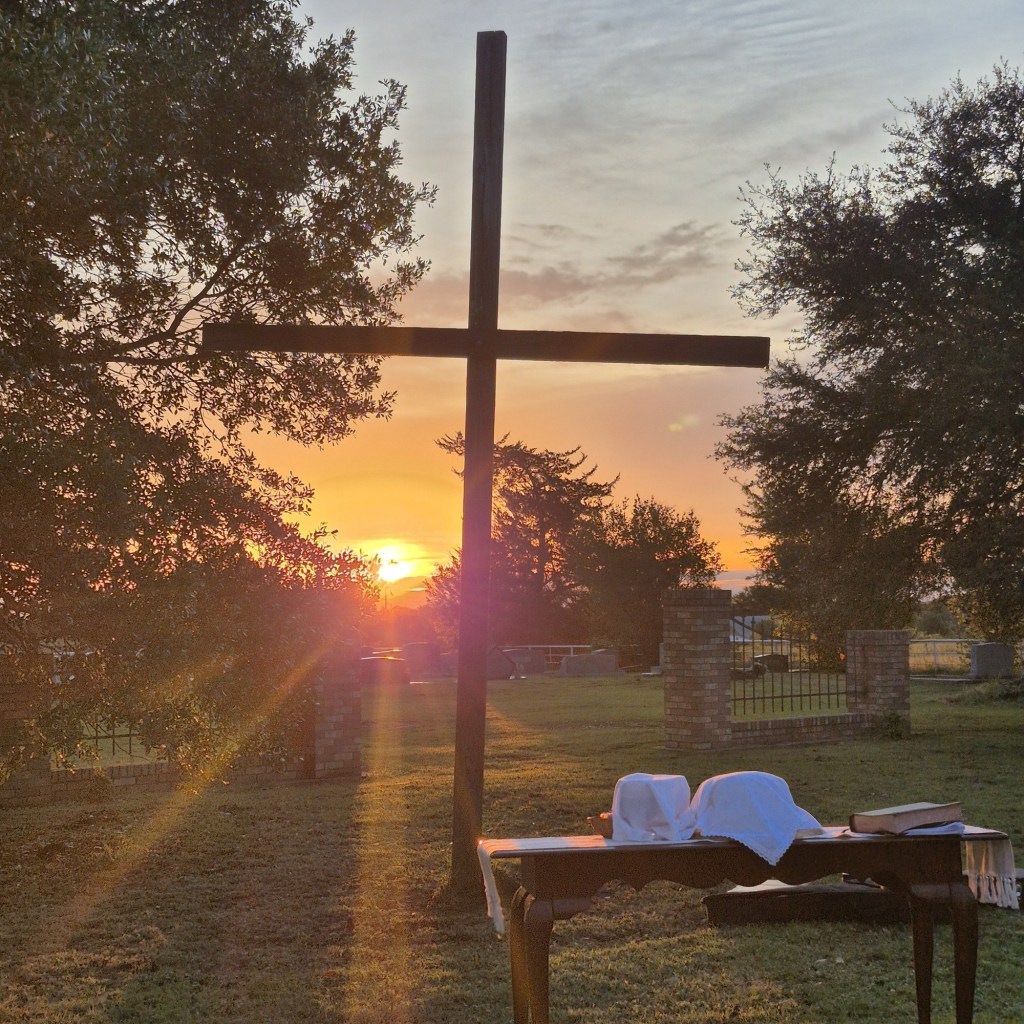
Photo by Kendra McDermott taken before the sunrise service at Cooks Point Methodist in Caldwell, TX on Easter morning.
Calling Your Name (An excerpt from the Easter sermon)
John 20: 1-18
FOCUS: Mary recognized Jesus the Christ when she heard her name; Jesus is calling us, too.
MARY
Mary knew it was Jesus when she heard him speak her name.
She heard a voice she thought she would never hear again, but at first it wasn’t familiar. Mary knew grief, perhaps deeper than ever before in her life. She knew abandonment and she knew loneliness, but perhaps never like she did that morning.
Mary started toward the tomb of Jesus early in the morning, while it was still dark. With the breaking of the sun, the Sabbath was over. She could go to the tomb of her friend, her Lord, her teacher, and give him the love and respect in death that had been denied him so violently in his last days of life.
The four Gospel accounts vary from one another. There are different arrangements of time, there are different people present, there are many differences. But one person is true to all four accounts of this day that changed the world: Mary Magdalene.
This loyal follower of Jesus waited until the Sabbath was over, and headed toward the tomb where she had seen the body her fried, her Lord, her teacher, placed. Joseph of Arimathea, who had been a secret follower of Jesus up until his death, asked Pilate, the Roman governor, for permission to take the body.
It was Friday, and the Sabbath began at sundown. Pilate granted the permission, and Joseph came and removed the body. Nicodemus, also a secret follower of Jesus that was among the religious leaders, and who had come secretly to Jesus one night early in John’s Gospel account, came with him. Nicodemus brought 100 pounds of myrrh and aloes, and they wrapped the body of Jesus in linen cloths along with the fragrant mixtures, and placed the body in a tomb carved out of a rock located in a garden… in the place ..where Jesus was crucified. A huge stone sealed the entrance to the tomb.
WHAT HAPPENED
When Mary Magdalene arrived, she saw that the tomb had been opened; the stone had been removed. She left immediately, and ran to Simon Peter and the other disciple, “the one whom Jesus loved”, to tell them what happened.
“They have taken the Lord out of the tomb, and we do not know where they have laid him.” Then Peter and the other disciple set out and went toward the tomb. The two were running together, but the other disciple outran Peter and reached the tomb first.
We are not sure who the other disciple is, but traditionally we believe it is John, partly because he keeps referring to the “one that Jesus loves.” And, he makes a point of letting us all know he outran Peter to the tomb.
The other disciple outran Peter, peeked inside and saw the linen cloths, but did not go in. Peter ran up and just ran inside. He saw the linen cloths lying there, and the cloth that had been on Jesus’ head, not lying with the linen wrappings but rolled up in a place by itself. Then the other disciple, who reached the tomb first, also went in, and he saw and believed; for as yet they did not understand the scripture, that he must rise from the dead. Then the disciples returned to their homes.
The two disciples rushed there, and our scripture says they both eventually went into the tomb, saw the linen cloths seemingly put away – it’s worth noting that in another resurrection story Lazarus comes out of the tomb at Jesus’ command, but he is wrapped in his grave wrappings.
We are told they believed, but we don’t know what they believed. We do know what they did – they left; they went home.
Mary remained. Perhaps more alone than ever. She reached out to men, one more time, and she was left. Probably the only man in in her life who loved her for who she was and not for what she could do for him had been taken from her. He had been betrayed by one of the group she knew, one of his own disciples. And he had been further betrayed by the religious leaders, those who were supposed to teach her and everyone else about God, who were supposed to show her the path to God.
What do we do when all seems lost? Where do we turn when everything seems to go wrong? Too many don’t know where to turn, they lose hope. For too many the false promises of seeking wealth. or of the shallow relationships that pass for love or of the empty philosophies that are exposed as shams…when we put our trust, when we put our faith, in the wrong place, it can be devastating.
Suicide rates are up, particularly among young people. Medically assisted suicides in Canada were attributed to one in 20 in 2024 — medical issues including depression, and seasonal affective disorder.
Where do we turn when there seems to be no way out? Hank Williams turned to drink. The man who wrote “I Saw the Light” and so many wonderful songs died from alcoholism in the back of a car one New Year’s Eve. He told a friend that he couldn’t see the light anymore.
Many of us have been in dark, dark places. Sorrow, grief, hope shattered..
In Jesus Mary had seen something she had never seen before: she saw a love she had never seen before. She saw a relationship with God, with Abba Father – Daddy! – that she had never seen before. And the religious leaders, who kept claimed to represent the Lord of all creation, seemed so cruel and vindictive and …yes, evil. They orchestrated the killing of Jesus by blackmailing the Roman governor, telling him Jesus had to die. And when Pilate asked them if Jesus was the king of the Jews, and if they wanted to crucify their king, they called out the saddest line in the Bible: “We have no king but Caesar!” These religious leaders, blind with hatred and ambition, declared Caesar their king and thereby renounced the Lord they claimed to serve.
Mary knew all that. And she saw the beatings, and she saw the cruel taunting, and she saw the crown of thorns and the crucifixion of Jesus. And she saw him die, and watched as his body was placed in the tomb.
And now the body was gone. And the men she counted on for help, well, they were gone, too.
Here’s our Scripture:
But Mary stood weeping outside the tomb. As she wept, she bent over to look into the tomb; and she saw two angels in white, sitting where the body of Jesus had been lying, one at the head and the other at the feet. They said to her, “Woman, why are you weeping?” She said the them, “They have taken away my Lord, and I do not know where they have laid him.” When she had said this, she turned around and saw Jesus standing there, but she did not know that it was Jesus. Jesus said to her, “Woman, why are you weeping? Whom are you looking for?” Supposing him to be the gardener, she said to him, “Sir, if you have carried him away, tell me where you have laid him, and I will take him away.”
Our Scripture paints such a vivid picture. She’s alone and terribly sad. She is grieving for the loss of her friend, her Lord, her teacher, and now something has happened to his body – some other act of cruelty has taken place, as if killing Jesus were not enough.
But then, something happens – and her world, and our world, would never be the same.
HEARING YOUR NAME
Jesus said to her, “Mary!” She tuned and said to him in Hebrew, “Rabbouni!” (which means Teacher). Jesus said to her, “Do not hold on to me, because I have not yet ascended to the Father. But go to my brothers and say to them, “I am ascending to my Father and your Father, to my God and your God.”
She heard Jesus when he called her name.
She heard what she thought she would never hear again.
Jesus was alive!
And nothing would ever be the same again!
Jesus gave her a task – she was to go and tell the news to the disciples. (By the way, this makes Mary the first evangelist, the first to proclaim the great news.)
Mary announced to the disciples “I have seen the Lord!” and told them all Jesus had said to her.
So let me ask you this: what if this is true? What if God was put to death, bearing our sins, yours and mine and all the world, and rose from the dead conquering death itself?
What if it is true? A gift you can’t earn, a grace you cannot even understand, a new life offered from the struggles to do everything on our own.
We understand sin, don’t we? We believe in such a thing as evil. How can you look at the world and not see it?
What if the weight of that sin was carried by Someone else? That crushing weight you barely admit to yourself, what if Someone could take it from you? Someone who knew the pain, someone who knew the cost, someone who would bear the weight even to the point of death?
What if it is true? What if the power of forgiveness, the power of love is strong enough to break the power of sin?
All of us here know sadness. All of us here know grief. Most of us here know despair and deep loneliness, and may have felt like giving up.
But don’t.
Just don’t.
In the midst of the darkest place, a dawn can come. In the midst of the silence of loneliness, you can hear a sound. It may not be right away, and it may get worse before it gets better, but there is a sound for all of us to hear.
There is a sound made just for you, and just for me, and just for everyone.
The sound is the giving of hope, the giving of promise, the giving of life itself: it is the sound of Jesus calling your name.
I hope that today, of all days, you hear that sound. Maybe for the first time, or maybe hear it again.
But there is nothing sweeter or more profound in the world than hearing your name called out by Jesus.
Listen with me.
What if this is true?
In the name of the Father, and of the Son, and of the Holy Spirit.
This is roughly the text of the Christmas Eve 2025 sermon, given at Cooks Point Methodist Church in Caldwell, Texas.
photo from Pixels
Isaiah 60: 1-5
John 1: 1-14
FOCUS: Jesus is the Light of the World; and in that light we see Light.
John 1: 1-14
1In the beginning was the Word, and the Word was with God, and the Word was God. 2He was in the beginning with God. 3All things were made through him, and without him was not any thing made that was made. 4In him was life,a and the life was the light of men. 5The light shines in the darkness, and the darkness has not overcome it.
6There was a man sent from God, whose name was John. 7He came as a witness, to bear witness about the light, that all might believe through him. 8He was not the light, but came to bear witness about the light.
9The true light, which gives light to everyone, was coming into the world. 10He was in the world, and the world was made through him, yet the world did not know him. 11He came to his own,b and his own peoplec did not receive him. 12But to all who did receive him, who believed in his name, he gave the right to become children of God, 13who were born, not of blood nor of the will of the flesh nor of the will of man, but of God.
Jesus gives me the light to see, to see things in a particular way. Our Scripture says that in him was life, and the life was the light of men. The light shines in the darkness, and the darkness has not overcome it. I want to talk about light and darkness tonight, how it applies to Jesus coming into the world, and end with a question for all of us to consider.
Light and darkness, being blind and seeing, are themes not only in John’s gospel but throughout the Bible.
In the first words of the Bible, Genesis 1:1 and following, we read:
In the beginning, God created the heavens and the earth. The earth was without form and void, and darkness was over the face of the deep. And the Spirit of God was hovering over the face of the waters. And God said, “Let there be light,” and there was light. And God saw that the light was good. And God separated the light from the darkness.
God spoke, and the light appeared. And it was good. And the Lord separated the light from the darkness. It was the word of God that created light.
In Psalm 36:9 David prays to the Lord, “For with you is the fountain of life; in your light do we see light.”
The Lord teaches us to see from a different perspective. In Psalm 61:2 David again cries out to the Lord, “…from the ends of the earth I call to you when my heart is faint. Lead me to the rock that is higher than I.”
We can only see things that are right in front of us; we can’t see the larger perspective, as God sees. Lead me to the rock that is higher than I…
For instance, we may think we can be made right with God by our behavior, by acting right or not acting wrong, or by making sure we read our Bibles and pray, and fast. These are all good, but they don’t deal with our sin, the sin that keeps us from a holy God. We walk in darkness, trying to find our own way.
God shows us the way.
In Psalm 119: 105 we read, Thy word is a lamp unto my feet, a light unto my path. When this was written thousands of years ago, the dark roads were lit only by the lanterns or lamps carried by the traveler. You could only see a few feet, just the path in front of you. In Proverbs 3: 5-6 we learn to trust in the Lord in all your ways, lean not on your own understanding. In all your ways acknowledge him, and the Lord will direct your path.
God shows us the way.
For hundreds of years, animals were offered in sacrifice to atone for sins, to make us one with God. But these were not lasting, they were over and over.
God not only shows the way, He provides the way.
The prophet Isaiah prophesied that Someone was coming, that God would provide. In 9:2 he wrote, Those who have walked in darkness have seen a great light. Those who dwelt in the land of deep darkness, on them a light has shown.
What does this idea of darkness mean? It doesn’t take a prophet to realize we live in a deep darkness now. Anger, even rage, addictions, alienation from friends and family over politics, suicide rates are up among young people, medically assisted suicide has become a major cause of death in Canada — one in 20 according to some figures released in 2023. In 2027 those suffering with mental illness, including depression, will be able to qualify for the medically assisted death. (The M.A.I.D. Program). How difficult do you think it will be to get a diagnosis of depression? Have you looked into the difficulty of getting a medical prescription for marijuana in the states that allow it?
And what’s God got to do with all this? How could a loving God allow such suffering, such a depth of darkness? Does He really answer prayer? Does he even exist?
The folks who first heard the prophecy from Isaiah 60 would have wondered these things, too. They had lost their homeland, and were being held in captivity in Babylon. I imagine many of them had given up all hope. The Lord they had counted on seemed to have deserted them, or abandoned them. Or maybe they had been fooling themselves all along.
Isaiah 60: 1-5
Arise, shine, for your light has come, and the glory of the LORD has risen upon you. 2For behold, darkness shall cover the earth, and thick darkness the peoples; but the LORD will arise upon you, and his glory will be seen upon you. 3And nations shall come to your light, and kings to the brightness of your rising.
In Matthew’s account of the crucifixion, on the day Jesus died upon the Cross, a great and thick darkness covered the land from noon until 3 pm, the hour Jesus died. But the darkness did not last; Jesus rose from the dead when and the glory of the Lord was seen on him, and all nations are coming to his light now, the gospel going out into the whole world.
Darkness and light — it’s a theme throughout John’s gospel and all of Scripture. Jesus is the Light of men, and the light that shines in the darkness, and the darkness cannot overcome it. The creative Word of God became flesh and dwelt among us. Scripture says he came to the world he created, but we did not know him. To those that did recognize him, he gave the power to become children of God.
When we live in the darkness of our imaginations, when we live in the darkness of our long cherished resentments, our fears, our anger, our grudges, our lust, our greed, our readiness to run over someone to get what we want or what we think we deserve — when we live in the darkness of addiction to alcohol, other drugs, our addiction to hate — we stop looking for the light of life.
But that light of Christ is ready, and the darkness cannot overcome it.
In just the past few weeks I’ve been thinking a lot about walking in darkness, without having the freedom Christ offers. If we turn our lives to Christ — and, at least for me, it has been a long and continuing process (as my family can tell you!) — and feel his love, his forgiveness…then it is as if a light dawns and we didn’t realize we were in such darkness until the light appeared. And in the light of Jesus, we can see, we can see how blind we were before…
Leadme tothe rock thatishigherthan I..
This story of Jesus is a true story, you know. There is no doubt historically about Jesus of Nazareth. Historians agree that Jesus lived, and had a following, and was crucified. Matthew, Mark, Luke and John, as well as the rest of the New Testament, are historical documents as well as theological ones,. and there is more historical proof for the life and death of Jesus of Nazareth than there is for Socrates or Alexander the Great, among others.
But historians have real difficulty with the Resurrection. How can that be true? I know this is Christmas Eve and not Easter, but the manger ties directly with the Cross and the empty tomb.
But all historians agree that SOMETHING happened that first Easter morning. Christianity grew and spread through the witnesses of the resurrection, because of the new life and the new way of treating others. Many of the early Christians died as witnesses, martyrs for the faith. All but one of the 12 disciples died violent deaths. Why would they do this if they had not seen the risen Jesus? They had no more money or power than these shepherds in our story — keeping watch over their flocks by night. And an angel of the Lord appeared to them, and the glory of the Lord shone round about them, and they were sore afraid. And the angel said unto them, “Fear not, for behold, I bring you good tidings of great joy which shall be to all people. For unto you is born this day a Savior, which is Christ the Lord.” (from Luke 2)
But something happened.
And they were different.
Why does God allow suffering? Jesus embraced suffering by enduring the betrayal, the beatings, the torture, the death upon the Cross. Jesus embraced our suffering
And on the night He was betrayed, in the Garden of Gethsemane, Jesus prayed three times that “this cup be taken from me”. He prayed three times, and ended with “not My will, but thine.” There is a depth of faith here that resonates beyond understanding.
So here is the question I want to leave with you. Do you believe this story is true? Do you believe Jesus is God who came into the world to save you from sin, to bring you from darkness to the light of life? Do you believe Jesus saves your life not only now but through eternity?
C.S. Lewis, a prominent Christian writer of the 20th Century, wrote that Christianity, if true, was of most importance. If it was not true, it was of no importance. What we cannot say is that it is of some importance.
I believe there is no more important question than this. Do you believe Jesus is who He says He is, Who the Bible says He is? I pray for all of us that Christ can be born anew or born for the first time in our hearts tonight, that we might walk in the promised light of Christ — because a baby was born in Bethlehem.
In the name of the Father, and of the Son, and of the Holy Spirit. Amen
I play banjo in a prison band. I don’t know if I’ll ever apply for a job again, but if I do, that happy fact will lead my resume.
I’m part of a team that brings the Kairos ministry training , that brings the hope of Jesus, the light of Christ into the dark world of the Wallace Pack Unit in Navasota, Texas.
In a recent training, the “brother-in-white” who plays bass said he had worked with a banjo player who opened the gospel hymn “I Saw the Light” with “Foggy Mountain Breakdown”, a signature banjo piece that is fast and complicated. I’ve never learned to play it well, just taking a stab at it, missing many of the notes that make it so driving and intricate.
By playing with others I’ve realized my limitations on the instrument, and I’ve decided to start over with the basics. Today I’ve practiced the “forward roll”, the steady repetition of eight sequenced notes on three strings: thumb, index finger, middle finger; thumb, index, middle; thumb, middle. Over and over with the right hand, and moving different formations along the neck with my left. Using a metronome, 60 beats per minute, getting the rhythm steady. Becoming grounded in the pattern, anchored in the music so that you can speed up or slow down, and being ready for the next challenge.
I had neglected the basics.
So why am I writing this? Because my habits were not formed well, and I’m correcting it now, in music and in life.
Some of the best advice I’ve ever received was from my first District Superintendent, when I lamented over the length of time it took to be ordained in the Methodist Church.
“Don’t rush the spiritual formation process,” he said. “Otherwise you won’t be spiritually formed.”
We need to be grounded in the fundamentals. And as I was practicing the forward roll with the metronome I thought about getting grounded in the faith. Becoming a disciple is getting the basics down solid, and if we don’t do that we can die out, like the seed planted on rocky soil.
Practicing spiritual disciplines, like I have learned since being involved with the Inspire Way of Life, is the grounding that I need. When I first came to Jesus, I learned a few things, and thought I knew it all. I did not have a “band” around me, or anyoneS that I allowed to teach me. I was like a train wreck, harming myself and others as I married poorly and divorced quickly, all thinking i was acting in the will of God.
What did I not do? Pray for God’s will, and be willing to listen. Study Scripture, and be in a relationship with others that I trusted. I did not fast to seek God’s will for myself or others.
Fasting in particular makes me aware of my impulsive desires, and eventually leads me closer to the Lord.
Prayer, fasting, Scripture, fellowship, serving others — these are basic practices. Studying and starting to memorize the Sermon on the Mount has been transforming. Such things don’t lead to salvation, but they give a greater awareness of who Jesus is and what He has done. They can help lay a foundation, a practice, and I will do well to go back to the basics of faith regularly, to strengthen the foundations like practicing a forward roll.
Members and friends of our church met at the Cracker Barrel this morning for what is becoming for many of us our favorite Christmas tradition: Bless A Server. Karen, one of our members, saw this on Facebook several years ago and thought it was something we could do, too.
She contacted the manager of the local restaurant and told him what we wanted to do. Could he choose someone among his staff who could really benefit from a Christmas blessing? We came for breakfast together, and gave what we could over and above as a blessing, often several hundred dollars. Each time the right person was chosen. One young lady had that morning told her children there would be no Christmas for them; she had enough money for her car payment and their food. When she received her envelope she cried, and told us what it meant for her and her family. “This is Christmas!” she said. We told her who we are, and we reminded her Who Jesus is, and there were hugs and tears.
Each year is different. This year one of the servers went to the new manager and suggested he choose one of her co-workers for the blessing “if that church comes back this year.”
Sally (not her real name) has several children, works hard and is struggling. It was arranged for her to be the server and recipient of the blessing. but she wasn’t there today, and the server who recommended her waited on us, and promised to get the money to Sally. This year 24 people showed up for breakfast, and more donated for a total of $2,001. (One of our little boys gave $1)
Maybe it’s even better that we don’t know the server. We don’t do this for recognition or for “stars in our crown”, but we give because much has been given to us. Jesus gave His life for us, for me and for you too. We want the love He gave us, He gives us, to be shared and multiplied in our homes, in our neighborhoods, in our world.
We have our issues, our struggles, too. Many of us have health issues, family problems, financial concerns. We give because we’ve been broken too, we give because someone helped us and showed love to us. We give because God loved us first.
There is no fear in love. But perfect love drives out fear, because fear has to do with punishment. The one who fears is not made perfect in love. We love because he first loved us. (1 John 4: 18-19 New International Version)
At the beginning of every meeting of Alcoholics Anonymous I’ve attended someone is asked to read the 12 Steps. We move from the first step — admitting we are powerless and our lives have become unmanageable — through a process of realization and transformation, if carefully followed.
The 12th step reads: “Having had a spiritual awakening as a result of these steps, we tried to carry the message to alcoholics, and to practice these principles in all our affairs.”
So we move from a state of not being able to manage our lives to a focus on helping others. This is an ongoing process, and in the paragraph following the steps we read that no one claims perfect adherence to these principles. “The point is, that we are willing to grow along spiritual lines. The principles we have set down are guides to progress. We claim spiritual progress, rather than spiritual perfection.”
Progress, not perfection.
Behind this idea is one of self-forgiveness. If someone who had been a lifetime drinker or abuser of drugs “falls off the wagon” after the first month or so of sobriety, we don’t need to condemn; that’s happening already. What we can do is celebrate the steps so far, and encourage a new beginning. “How long has it been since you were sober that long? You can do it!”
1 John 3: 20 -If our heart condemn us, God is greater than our heart, and knows everything.
The same kindness can be shown in our journey with God. Progress, not perfection. Grace shows us that progress comes from the realization of the depth of our sin, the unbridled wildness of God’s love, and the unmerited gift of grace. Jesus did it all.
You’re not where you want to be? Or where you think you should be? Or where others expect you to be?
So what?
It’s not about you; it’s not about me; it’s about Jesus.
Remember that. And start over if you need to. Progress, not perfection.
Kairos is a prison ministry designed to bring men and women to an encounter with Jesus Christ. After many setbacks our team went into the Wallace Pack Unit in Navasota, Texas at the end of April.
We meet in the big gym starting Wednesday afternoon and ending Saturday, with 42 “brothers-in-white”, many of whom have waited for years to come to Kairos. Some come because of the food — which is excellent, especially considering their daily fare.
Some attend because they have seen a difference in others who have gone before, and others because it is something different.
There are many stories to tell, and I know only a few. I’ll share two.
After the first day, one man said he wanted to talk to one of the clergy — the Spirit seemed to be stirring him up. He said this at the end of the day, so we could not meet again until the next morning.
We pulled him out of the lineup waiting to get in, and I sat down with him to hear his story.
His father was an evangelist, and they traveled together when he was young. He was licensed to preach at 16, but never entered the pulpit because “all the hypocrisy”. I didn’t pursue what happened to change him, and let him go on.
He tried to find God in other ways, other faiths, eventually exploring witchcraft and other “dark arts”, which contributed to me meeting him in prison.
He feared he had gone too far, that he was out of the reach of God. He cried as he told me.
Together we spoke of the promises of God, of the entire Bible being the story of redemption, of people turning away from God’s love and the Lord being ready to receive back those who repent and turn to him, even running down the road to meet us as the father in the Prodigal Son story. We spoke of Psalm 139, where there is no place we can go beyond the reach of God.
And of course he thought he had committed the unforgivable sin. (Don’t we all?) I told him I could be wrong, but I think the only unforgivable sin against the Holy Spirit is believing we have gone out of the reach of God and therefore do not ask for forgiveness. Being tortured by the worry is a sign of God’s call, or so I think.
We prayed and he offered his life once more to Jesus, and we both walked out of that room changed.
The second story comes from the closing ceremony, where graduates attend as well. A man came up to me, and asked if I remembered him.
I did. He has a triangle tattooed on either side of his left eye and the logo of a football team tattooed on the back of his head. Yes, I remembered.
“I’ll admit, I came to Kairos for the food,” he said. “But after a couple of months, it began to sink in, and I’ve changed. I’m following Jesus now!” And he beamed as he hugged me.
I will sing of the steadfast love of the LORD, forever; with my mouth I will make known your faithfulness to all generations. For I said, “Steadfast love will be built up forever; in the heavens you will establish your faithfulness. “ Psalm 89: 1-2
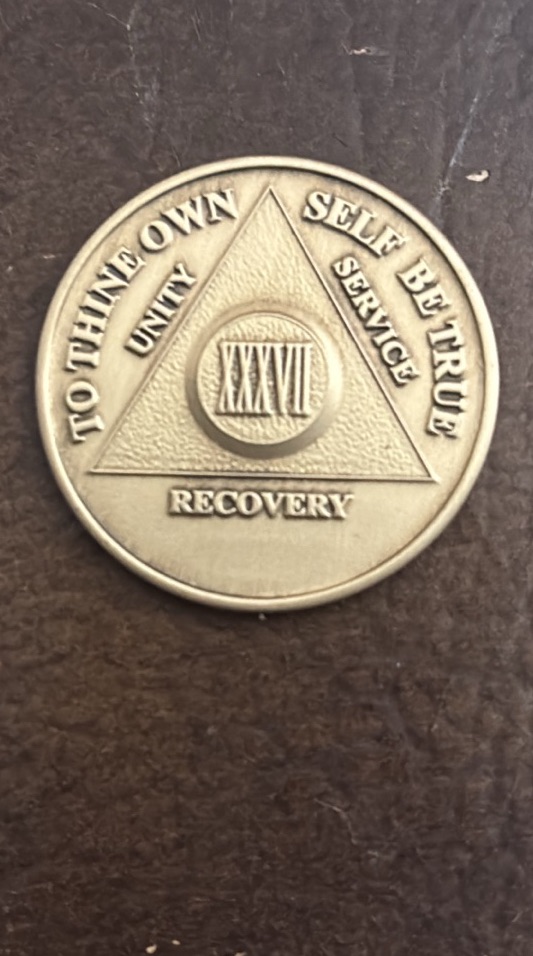
Perhaps what I’ve learned over these last 37 years of sobriety is something about forgiveness. At 70 years old I’ve passed the halfway mark now. I awakened to faith in Christ the last time in 1990, two years into the sober life. It was about four years before I worked the 4th step, “made a searching and fearless moral inventory…”
Jesse sponsored me, a grizzled old man with a fast handshake and a big heart. I came in with a “high bottom”, meaning I had not lost all yet. For the previous year I had been taking courses to become a Certified Alcoholism and Drug Dependency Counselor, and at one point I took one of the self-tests for alcoholism. There I was, still in Stage 1 but gaining momentum. I had a great fear of alcoholism because of my home life growing up, and I didn’t want to put my family through that one day.
I became close to Jesse and his family, and he brought me into his church. Many years later I would come back there as one of the pastors.
I don’t hold up my own program as a model for others, but I have stayed away from alcohol and drugs for a good bit of time now. I learned about forgiveness in a big way when I finally wrote the 4th step and went to Jesse for the 5th: Admitted to God, to ourselves and to another human being the exact nature of our wrongs.
I used the classic Seven Deadly Sins as a model for my writing, and I went to Jesse’s one afternoon. He prayed; I read everything aloud. He prayed and blessed me. We went out to his backyard barbeque pit on that afternoon in Houston, and he took out his Zippo lighter and set the pages on fire. I watched that confession flame and lift into the air and I felt a new freedom.
This blog started as an idea for the intersection of discipleship and recovery, and more and more I believe in forgiveness as the link to both. There’s five points to forgiveness that I teach now in a prison ministry and at our church. I’m grateful to Dr. Timothy Keller and his book Forgive for some of this.
Look to Jesus, not peers. Your peers will disappoint you.
Forgiveness means absorbing the loss. We have to absorb the loss if someone acts against us. If we say something like, “I’ll forgive you, but I’ll never forget this!” — we are not forgiving, we’re posturing. If we forgive a debt, we absorb the loss ourselves.
Jesus absorbed the loss Himself when He bore our sin upon the Cross. He paid the price, He absorbed the loss, He forgives completely.
We can’t do this. There’s no way.
Jesus can, and does, and we can through Him.
How do we begin? We make a start.
Proverbs 3: 5-6 — Trust in the Lord with all your heart, lean not on your own understanding. In all your ways acknowledge him, and the Lord will direct your path. (Make a step! God will show you the next one. You need to be moving.)
Romans 12: 1-2: I appeal to you therefore, brothers and sisters, by the mercies of God, to present your bodies as a living sacrifice, holy and acceptable to God, which is your spiritual worship. Do not be conformed to this world, but be transformed by the renewing of your mind, that by testing you may discern what is the will of God, what is good and acceptable and perfect.
Our minds need to be renewed, we need to find a new way of thinking and seeing things, what Jesus called being “born again.” But once we are born again, we have to continue to grow up.
The Twelve Steps of Recovery are an outline of salvation leading to discipleship, and I believe useful for everyone.I’ve used them and recommended them and studied them for years, and sought help and community in churches and in the rooms of Alcoholics Anonymous.
Forgiveness is the key, or so it seems to me. Keep moving forward, trust in the Lord, and the He will direct your path.
Because he holds fast to me in love, I will deliver him; I will protect him, because he knows my name. When he calls to me, I will answer him; I will be with him in trouble; I will rescue him and honor him. With long life I will satisfy him and show him my salvation. Psalm 91: 14-16.