My friend Pete could be a real pain. He was tall and could be intimidating. Pete was a Marine, serving our country and was still ready to defend our country with his life, if necessary.
Pete believed in the Gospel of Jesus Christ, and lived by Romans 1: 16 — For I am not ashamed of the gospel of Christ, for it is the power of God unto salvation to every one that believes, for the Jew first, and also to the Greek.
I know he wasn’t ashamed because shortly after I became pastor at his church he came to question me, and see where I stood. I think I was often found wanting.
Pete and I had many conversations over the years I served as his pastor, and most of them started off with, “Frank, we’ve got a problem.”
For a long time I’d feel a twinge when I saw his name come up on my phone. We talked and often argued for hours over worship services and what direction the church should go and what stands I should or should not take from the pulpit.
Things got to a point where one day I said to him:
“Pete, the thing is, you don’t like me, and you don’t like my ministry. But here’s some hope: I’m here now, but I’m a Methodist pastor. I won’t be here forever! Wait it out! In the meantime, find someplace to worship where you can be happy.”
But we hung in there with each other.
A series of things happened after that, and I had a realization, a recognition, about Pete while crossing over the Lake Houston bridge. I think the Holy Spirit convicted me, and I called Pete and told him how much I appreciated him, and told him for the first time that I loved him as a brother in Christ.
Our relationship completely changed.
Suddenly I realized Pete did not go to someone else when he had a problem with me. He came to me first. We dealt with it. Pete did not talk behind my back, as I did about Pete to my shame. Pete stood up for his faith without reservation. I came to realize Pete Collier modeled Christ for me as a man of integrity in ways I did not appreciate. We kept in touch after Brenda and I left Lake Houston, and I think the last words we said to each other over the phone were words of friendship and love.
Yes, my friend Pete could be a pain, and he modeled an unwavering faith and conviction that blessed and changed me.
As it turns out from my reading and experience, Jesus could be a real pain, too.
Realization two…
An Embarrassing Moment
For some time now, I have wanted to deepen my prayer life. I have done many things, bought books and listened to podcasts. I took steps toward joining a group, an order, that emphasized prayer. (Never mind that I am a life-vowed member of another order that practices the Daily Office!)
While on yet another Zoom call, this one to talk about preparations for the next steps in discernment, I had an embarrassing realization.
Why don’t I just pray more? Why do I need all of this?
How many times have I used the seeking of more knowledge as an excuse for inaction?
A decade ago my wife and I were on a Wesleyan Pilgrimage in England, and we heard Phil Meadows for the first time. Phil is the co-founder of the Inspire Movement, and he talked about spiritual disciplines, including fasting.
Something about fasting resonated with my soul, and I said so to another pilgrim on our bus as we were leaving.
“Yes, I’ll need to read more on that”, he said.
It was like I was looking in a mirror, seeing how ludicrous I could be! Why not just fast? Why not just pray?
How many times have I bought another book on a type or style of music rather than just practice one of my instruments?
What am I waiting for? Whose permission do I need?
Recently I took part in the Kairos Training held at the Wallace Pack Unit in Navasota, Texas. Kairos is a time to have an encounter or maybe an awakening or breakthrough with Jesus in prison. Corresponding trainings are Walk to Emmaus or Cursillo. I’ve now served on several teams, and seen signs of resurrection, of light coming into darkness…and the darkness cannot overcome it. (John 1:5)
Many of these men have been imprisoned for many years, and may have retreated so far inside themselves that it is particularly tough to find a way out. Many have little contact with friends or family on the outside, and when they receive letters as part of the Kairos weekend, it’s the first they may have seen in years.
During the weekend a series of talks are given. The men are seated six to a table, along with three team members, including one clergy. After the talks, the men discuss the subject and then each table makes a poster for each talk, and later in the day each table shows the group their favorite posters.
Taking Part in Life Again
During the poster presentation the man who presented looked like he had suffered a stroke. He was sitting down, held his body stiffly and spoke while looking mostly straight ahead. He pointed to a dark, round circle on the white poster board and said there was a man who was down a hole, and he never thought he’d get out. But that man (it was obvious he was speaking of himself in the third person) had found a way out, and that man was talking and taking part in life again.
Two days later, the same man walked up to the microphone at the front of the room during a time of open sharing of what the weekend had meant. He was walking, standing, and looking around the room.
Jesus had shown him hope, he said. Jesus had shown him love, and he had a bigger purpose to serve the Lord where he was.
Telling the Secret
Another man said he had kept a secret for 50 years, never telling anyone, and he was almost ready to share. He had been in the military and served overseas, and he said wanted to share with someone with like experience.
While we were trying to find such a person, he came up to me and asked me if we could talk. I don’t have military background, but he told me it was all right.
He told me the story. He had been leader of an elite unit, the best of the best in specialized warfare, and he said he had seen and done some horrible things. One day he and his team were supposed to clear a building where they suspected there was danger. As team leader, he was to go in first. A young man, barely more than a boy, pushed him aside and ran in, and was killed instantly by a grenade.
For 50 years this man had carried the burden, carried the guilt, that it should have been him going in, it should have been him dying, the boy should still be alive. And he never told anyone.
Where is Jesus?
“Where was Jesus in all that?” I asked him. At first he was shocked, and then we started talking about where Jesus would have been. I steered clear of any kind of talk about God’s will, but I did ask if he knew of a more perfect example of Jesus’ sacrifice than what his young man had done for him and his team. We talked about the love of God, and that Jesus was with him then and with him now, and he was lightened. And God began the process of releasing him.
We had been talking about forgiveness, and were preparing a powerful forgiveness ceremony, writing the names of people, places and things — including God! — that we needed and wanted to forgive and feel the release. The names were written on special paper, and dropped into a tub of water. As one of the clergy stirred the water, the paper dissolved, disappearing into the cloudy water.
Following Jesus is about seeking the Lord, and seeking forgiveness. There’s real life out there, no matter our circumstances. It’s not a one-time event for most of us, but a leading, a trusting, a moving step by step with Jesus, and step by step in a community. (Proverbs 3: 5-6)
Questions to Consider:
Do you know anyone who has given up on hope?
Does the idea of visiting those in prison appeal to you?
Are there secrets you protect? Is there forgiveness that you withhold? Even from yourself?
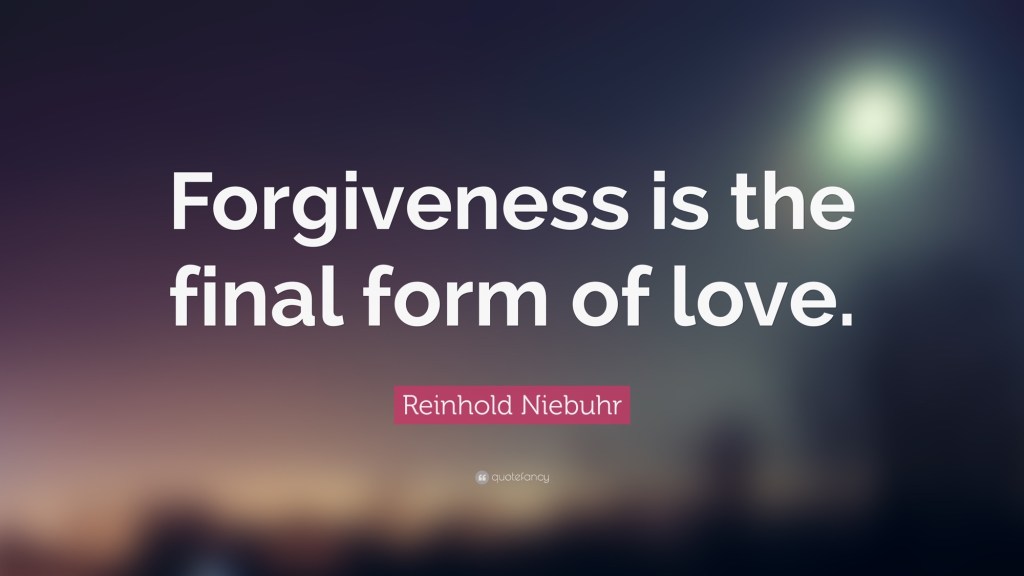
I love this quote, and Niebuhr is attributed with the Serenity Prayer.
The following is a sermon preached January 28, 2024 at Cooks Point Methodist, based on Matthew 18: 21-35.
FOCUS: We must forgive as we have been forgiven — and this is not a suggestion.
FORGIVENESS NOT AN OPTION
In the preparation for this sermon, I’ve been thinking and praying about the grudges I hold, the grudges I still hold, and how many I’m still so used to carrying that I don’t even notice until something flares up — some memory, some trigger for an old hurt, or a practiced anger or a cherished resentment, to use a phrase from one of my teachers. I’ve used that phrase before here, right? “Cherished resentments?” It’s those old hurts you trot out to yourself or others when you might want to feel sorry for yourself and maybe get some other people on board.
But I want to serve the Lord. I want to follow Jesus, and if I believe Jesus is Lord, and I do, then I need to do what he says, which is forgive, and forgive from the heart.
But honestly, sometimes I just don’t know how I can do it.
And I don’t think I can, without God’s help. But Scripture says if I draw near to God, God will draw near to me. And after all, Jesus came for me, and for you, to offer us an incredible gift, beyond any monetary or other value — God offers us forgiveness, freedom from the anger, freedom from the self-pity, freedom from pride — what others think of me. Jesus offers that, and I want it, and I hope you do too. There’s a wonderful line in Psalm 118:5 — Out of my distress I called upon the LORD; the LORD answered me and set me free. (Another translation reads: ”the LORD answered me with freedom.)
More and more, I think forgiveness is rooted in humility, in being broken before the Lord. At the beginning of Matthew 18 Jesus told his followers they must become like a little child to enter the Kingdom of Heaven. I think at least part of that image is that we need to be going to Jesus to learn how to live, learn how to be with others, learn how to communicate with God through His word.
From the next section of the chapter we know that temptations to sin are bound to come, but you don’t want to be the person from whom the temptations come. In other words, take good care of each other, and don’t lead each other down wrong paths. If and when we wander away, the Lord will search us down and give us a chance for repentance and return, as the parable of the lost sheep teaches.
Jesus then, in the section leading into our parable today, has a teaching on what to do if a brother sins against us. We go to him (or her) alone and try to resolve it. If that doesn’t work, you try again, this time with one or two others with you as witnesses. If that doesn’t work, you take it to the church. If that doesn’t work, you “let him be to you as a Gentile or a tax collector.” (Matthew 18:17b)
It’s worth noting that Matthew, the author of the gospel, had been a tax collector, and many Gentiles were among Jesus’ followers.
These confrontations were taken seriously, the relationship between believers was taken seriously. What we don’t have is someone ignoring the problem and pretending nothing happened. Gossip starts then, and gossip kills.
PARABLE OF THE UNFORGIVING SERVANT
So now we move to this parable of the unforgiving servant. The parable has two parts, like the Prodigal Son story in Luke’s gospel.
Before he starts the parable, there is a set-up, with Peter asking Jesus about how often should we forgive someone. When Peter offers seven as the magic number, he probably thought he was being generous. When Jesus answered 70 times seven, the Lord didn’t mean 490, but he meant unlimited forgiveness after repentance.
Then the parable. Most of you know the story. A king wanted to settle accounts with one of his servants, and the servant owed him a vast sum of money, 10,000 talents. There are various explanations of how much money a talent represents, but the one in my study bible said it was equivalent to about 20 years’ wages for a laborer. It’s an absurd amount — how could the servant get into that kind of debt? Jesus is using that image to make a point.
The servant could not pay the debt, and so the master ordered him to be sold into slavery, along with his wife and children and all his possessions, to help pay the debt.
The servant fell to his knees and begged to be given a chance to pay back the debt, begged for his life and the lives of his family, and the king showed mercy and forgave him, releasing him from the debt.
That’s part one.
Part two is the forgiven servant finds someone who owed him a hundred denarii — about 100 days work for a laborer — and demanded payment. When the fellow servant fell down and begged to be given time to pay, the man who had been forgiven so much refused, and had his fellow servant thrown in jail.
When the king found out what had happened he summoned the first man to come before him.
You wicked servant! I forgave you all that debt because you pleaded with me. And should you not have had mercy on your fellow servant, as I had mercy on you?
And in anger his master delivered him to the jailers, until he should pay all his debt. So my heavenly father will do to every one of you, if you do not forgive your brother from the heart.
OPTION OR OBEDIENCE?
So what do you think? Is forgiveness an option? When we pray and ask the Lord to forgive us as we have been forgiven, are we serious?
Pride keeps me from wanting to forgive. I don’t want to be seen as weak. I don’t want others to think of me as weak.
But was Jesus weak? Did he have an earthly ministry that changed the world in just three years by showing weakness?
No, he wasn’t. He showed a strength through humility.
In Tim Heller’s book, Forgive, there are four steps that took place for forgiveness in this parable.
The first is truth telling. You confront the person with what happened. You tell the truth.
The second is taking pity, trying to understand the other person’s situation, thinking beyond your own interests to try to see their point of view. This is really extraordinary.
The third is the cancellation of the debt. The king absorbed the loss himself. When we forgive, we must absorb the loss, not parade it in front of ourselves as a sign of our kindness or martyrdom. When we forgive, we absorb the loss.
This is hard. Keller writes that if we grant the forgiveness, eventually we will start to feel it. If we forgive someone, part of the journey for that being true and actual is not going down that old path of anger and resentment once the memory comes back. You pray, you remind yourself and God that you have forgiven that person and move on. The fourth step is to release the person. This is similar to the last of the Five Stages of Grief — the last step is acceptance. You release the person, and as you release more and more you find out that the person set free is yourself. (Out of my distress I called upon the LORD; the LORD answered and set me free.)
When we realize what God has forgiven us through Christ, what sin Christ has taken on for us, for me, for you — Christ absorbed the sin, bore our sin upon the Cross, and gives us new life in the Resurrection.
If we understand the truth of the Gospel, that we are saved by grace through faith and it is the free forgiveness of God, we should be transformed, renewed, given over to new life, born again in the gratitude of what God has done for us. When we still act petty and mean, and cheap — when there is no evidence of a transformed, regenerated life and we live just like we did before…this parable is a warning. Forgiveness does not mean that we still parade our wound.
Sometimes people will ask me if we can lose our salvation. I don’t think we will, if we have had a truly transformed life. If we’ve had an experience that wore off, like the unforgiving servant or the elder brother in the prodigal son story, this parable can provide a shock — and maybe it is a shock that can start a heart again.
Do you find yourself in this parable? Where are you in the story? Who do you need to forgive?
What are you going to do about it?
I’m asking you, but I’m talking to me, too. Freedom awaits us all.
In the name of the Father, and of the Son, and of the Holy Spirit,
God’s Promise — this is a sermon text preached at Cooks Point Methodist Church in Caldwell, TX, on December 10, 2023, the second Sunday of Advent.
Isaiah 40: 1-11
Mark 1: 1-8
FOCUS: God keeps His promises, but is not in a hurry.
THERE REALLY IS
Every now and then someone asks me if Jesus’ real birthday is December 25. Or someone will proudly tell me that the Christians just took over the pagan holidays and made them their own. Interesting, and there are some kernels of truth there, but it is not THE truth.
In his book of essays called God in the Dock, (this would mean God on trial) the English author and scholar C. S. Lewis wrote that throughout history there is a story that emerges from all cultures and religions, of a god who is killed and then comes to life again. In our Old Testament, the people of Israel are given more substance to the story, more direct promises from the God who actually came for us, promising salvation and relief in a time of darkness and despair. And in the New Testament we learn that it is God Himself who walked the earth, Jesus of Nazareth, who was not what we expected — often not what we expect now! — but came into the world with a different kind of redemption, a redemption of all of us, and the echoes of the true salvation stories that flows from one end of our Bible to the other, from Genesis to Revelation, are found in the great mythologies and even in fairy tales. There really is a prince who awakens the sleeping beauty, put into a deep sleep by the evil queen. There really is a warrior who slays the dragon. And that God that we’ve been waiting for — he’s already here.
A TIME OF DARKNESS
This season of Advent, the first of seasons of the Church year…this is a time of darkness. In much of the world the days are short and cold, and the hours of daylight are scarce. In London, for instance, the sun rose today a little before 8 am local time and will set a little before 4 pm. As the year progresses, the days are shorter, the nights are colder and longer.
But something happens each year to remind us of a promise. The Winter Solstice on December 22 marks the official beginning of winter, but more importantly it signals the beginning of the days becoming longer, of light coming back into a world of darkness. So hear again these words from the opening of John’s Gospel:
In the beginning was the Word, and theWord was with God, and the Word was God. He was in the beginning, with God. All things were make through him, and without him was not any thing made that was made. In him was life, and the life was the light of men. The light shines in the darkness, and the darkness has not overcome it. (John 1: 1-5)
One reason for celebrating the seasons of the church is to remember the promises of God. Jesus comes into the darkness of the world and brings light the darkness cannot overcome. And we would do well to observe this, to remember this, every year either until our death or until Jesus returns for the final time at the end of the age.
Because now we face Advent in a time of war, we face darkness in a time of war. There are wars in the Ukraine and Israel, and they may expand. Here in the United States we face a presidential election next year in which the majority of the polls tell us folks want neither of the two leading candidates.
But this is not the only time we’ve faced darkness.
Eighty two years ago our country entered World War 2 after the bombing of Pearl Harbor by Japan on December 7, 1941. We declared war on Japan and Germany and the war years were dark indeed.
Jesus said there would always be wars and rumors of wars until the end of the age. There is a darkness in our souls, there is a darkness of sin, which is the great struggle in the world, from the beginning until the end.
The time of the Isaiah passage was a time of darkness and despair and a loss of hope for God’s chosen people, the people of Israel. They had been promised that God would always have a king in the ancestral line of King David, and that he would always be on the throne in Jerusalem. This promise was made and recorded in our book of 2nd Samuel chapter 7.
But, like many of us, the leaders and the people overlooked the “if” clause — if they obey, if they follow the commandments of the Lord, if they worship the Lord God alone and don’t offer sacrifices to other gods….
The “If” clause — it’s good to have a regular health check to see where we are with the “if” clause, for ourselves and our church. Are we pursuing God’s will for us or what would seem like success? Are we growing deeper in discipleship with Jesus as the years go by, or are we complacent?
It’s good to ask, isn’t it?
Back to Isaiah….As a result of not following the Lord, of not listening to the prophets that had been sent in warning over and over again, of worshiping other gods and then assuming the Lord would bail them out in times of trouble, the kingdom of Israel was destroyed. First there was a civil war splitting the country in two, and foreign powers overwhelmed both.
The remnant, left from the southern kingdom of Judah, were taken into captivity in Babylon. Jerusalem was invaded and the temple where they worshipped the Lord was destroyed. The king was taken from his throne. It seemed like darkness had come on the land, and that the promises of God were gone.
So keep that in mind as you hear these words again from Isaiah, chapter 40, starting at verse 1:
Comfort, O comfort my people, says your God. Speak tenderly to Jerusalem, and cry to her that she has served her term, that her penalty is paid, that she has received from the LORD’s hand double for all her sins.
A voice cries out: “In the wilderness prepare the way of the LORD; make straight in the desert a highway for our GOd. Every valley shall be lifted up, and every mountain and hill be made low; the uneven ground shall become level, and the rough places a plain. Then the glory of the LORD shall be revealed, and all flesh shall see it together, for the mouth of the LORD has spoken….
And the beautiful passage goes on to tell us that while season pass, and flowers fade, the word of the LORD endures forever. All people are like grass, but the word of the LORD is eternal.
So we learn from this passage that the word of the LORD is eternal, and with an eternal perspective. We, who are like grass, bloom and grow and fade and are gone, but the word of the LORD is forever.
God’s promises stand the test of time. God’s word, our Bible, does not expire or lose its authority or relevance. God keeps his promises, but God is not in a hurry.
So now think of a people still waiting for the LORD to intervene, for the Messiah to come and free them from the bondage, this time to the Roman conquerers 2,000 years ago.
And Mark’s gospel begins:
The beginning of the good news of Jesus Christ.
As it is written in the prophet Isaiah, “See, I am sending a messenger ahead of you, who will prepare your way, the voice of one crying out in the wilderness: ‘Prepare the way of the Lord; make his paths straight,’” so John the baptizer appeared in the wilderness, proclaiming a baptism of repentance for the forgiveness of sins….
THE GOD WE EXPECT
God came into the world, the Messiah arrived, but not as they expected then, and not as we expect now. Jesus came as a baby, to become a shepherd of the people as Isaiah proclaimed, and as a “suffering servant” who would take on the sins of the people, who would be bruised and beaten and killed to the sake of the people who killed him, for the world he came to save. He preached, like John the Baptist preached, repentance and forgiveness. He preached healing, and the strength of love.
He did not preach sentimentality or slogans. And he was killed by those who tried to control him or conform him to their idea of what a holy man would look like.
And he rose from the dead to show there is another way.
God rarely shows up as we expect him. And for those of us who are dealing with disappointment, with grief, with tragedies maybe known only to you, and especially at this time of year, hear these words again:
Comfort, of Comfort my people, says your God. Speak tenderly to Jerusalem, and cry to her that she has served her term, that her penalty is paid.
And hear once more the cry across the generations:
Prepare the way of the Lord; make his paths straight.
See, friends, it is the good news of Jesus Christ — It’s news, not a story. It’s news, not a myth or a tradition. It’s news…
It really happened. The God we have been expecting is with us now. The Light has come into the world.
In the name of the Father, and of the Son, and of the Holy Spirit.
It takes humility to follow Jesus. It takes humility to be obedient to the One who tells us to bless those who abuse us, to pray for those who have wronged us, to ask forgiveness when we’ve wronged them.
It takes humility to achieve recovery as well. It takes humility to introduce yourself every time you speak at a meeting, “Hi, I’m Frank and I’m an alcoholic.”
I’m working on a sermon based on Matthew 23: 1-12, in which Jesus takes the religious leaders to task for their pride, for their arrogance, for their wanting the best seats, the fanciest clothes, the prominent place in the culture. They sit in the seat of Moses, Jesus said, so do what they say when they teach the Law — but don’t do what they do.
Dallas Willard wrote that a key missing ingredient in most discipleship studies is obedience. (The Great Omission: Reclaiming Jesus’ Essential Teachings on Discipleship, 2006) We have techniques for growing churches, we have workshops for song leaders and preachers, we have programs to take our churches “to the next level”, but what we don’t have is obedience to the One who called us, who came for us, who died and rose from the dead for us. We don’t have a lot of that, and in the workshops I’ve attended for church growth and preaching, I’ve not heard that mentioned. (This has more to say about where I received my training.)
In other words, walk the walk. Live with integrity. Live with humility. How can we not forgive someone for things done to us when we have been forgiven so much more?
In Luke 6:46, Jesus asked his followers: “Why do you call me ‘Lord, Lord’ and not do what I say?”
In John 14:21 Jesus said: Whoever has my commandments and keeps them, he it is who loves me. And he who loves me will be loved by my Father, and I will love him and manifest myself to him.” So here Jesus is saying that if we obey Jesus’ teachings we will not only be loved, but Jesus will “manifest” himself to us, he will show up!
The prophet Jeremiah was told in 45:5 not to seek great things for himself, but that God would give him his life as a “prey” (KJV) — God will spare Jeremiah in the troubles to come, he said, but he will give him his life that others may “feed” off him, that he may nurture others in the word of God.
Jesus said something similar in Mark 10:45 — For even the Son of Man came not to be served, but to serve, and to give his life for many. Our lives are given to us in order that we might be servants to others. Jesus calls us to humility.
A journal given to me nearly three years ago that I unpacked and started using this week.
I tested positive for Covid again this morning. I first tested four days ago, and I am feeling so much better I was sure the virus had passed. But no…
My wife tested positive early in the week. We are blessed: we have food, family nearby, friends, and funds. We have no fever.
Now I wonder what to do with this time, this somewhat isolated time. I asked a friend to pray with me, that maybe God is showing me something, or stripping something away, or maybe I’m learning to pray. Psalm 46 has shown up often this week, not the least with the new journal pictured above.
Psalm 46 is such a powerful prayer:
God is our refuge and strength, a very present help in trouble. Therefore we will not fear through the earth gives way, through the mountains be moved into the heart of the sea, though its waters roar and foam, though the mountains tremble at its swelling. Selah
(As I write this I think of the devastating earthquake in Morocco, with thousands dead and injured, and rescue workers struggling in their work, and these words expand and resonate. We can use this Psalm to pray for them as well.)
There is a river whose streams make glad the city of God, the holy habitation of the Most High. God is in the midst of her; she shall not be moved; God will help her when morning dawns. The nations rage, the kingdoms totter; he utters his voice, the earth melts.
Maybe because I’ve been trying to memorize Psalm 1 that I see a connection with it here. Without quoting extensively, the Psalmist says the person who meditates on the law of the Lord will be like a tree planted by a river of water, whose tree bears fruit in due season, and whose leaves do not wither. The images are of an evergreen tree, and of stability. There’s a contrast between someone who seeks advice and counsel from the ungodly and the scornful. (You can scroll down any comments sections in Facebook or Twitter or any other social media and see this at work.)
Such a person is unstable, like “chaff in the wind”, the Psalmist says. I know this all too well.
So we go back to the river, whose streams make glad the city of God. God is in the midst of her; she shall not be moved. And maybe I can latch on to that stability by meditating on the word of God. Maybe so.
The LORD of hosts is with us, the God of Jacob is our fortress. Selah. Come, behold the works of the LORD, how he has brought desolations on the earth. He makes wars cease to the end of the earth; he breaks the bow and shatters the spear; he burns the chariots with fire.
“Be still, and know that I am God. I will be exalted among the nations, I will be exalted in the earth!”
The LORD of hosts is with us; the God of Jacob is our fortress. Selah.
I don’t understand the sovereignty of God. I don’t understand how the God who made all creation cares for me, but I believe it. And I believe the Resurrection of Jesus means that one day all will be well, in the words of Sam Baggins when he saw Gandalf toward the end of The Lord of the Rings, “everything bad is going to come untrue.” And maybe God is calling us to stop a little longer, to pray for the world, and to believe this truth.
Brenda and I at Checkpoint Charlie, the former crossing from East to West Berlin. Two of our guides in Germany said they never thought they’d live to see the Berlin Wall come down. One grew up in East Berlin and one grew up in West. Many died where we are standing, trying to cross to freedom.
A friend contacted me recently and asked me a couple of simple questions: What does it mean to seek God practically? How do we go about seeking God in our day to day lives? More and more I believe we do the small things over and over: we pray, we read the Bible, we keep going, and leave the outcome to God — where it rests anyway! The 12th Step begins: “Having had a spiritual awakening as a result of these steps….”
The awakening comes from the day to day work, from perhaps the tedious, but certainly through patience. Below is a reflection on Psalm 37, which can teach about trusting God, about obeying…and the link between trust and patience.
Psalm 37
I regularly read the Psalms, and like other parts of the Bible sometimes a familiar passage seems brand new, like Psalm 37 this week. This time through I started counting the commands — 15 in the first 11 verses, including “fret not yourself” three times!
Trust in the LORD, do good, dwell in the land, befriend faithfulness, delight yourself in the LORD, commit your way to the LORD, be still before the LORD, wait patiently for him, fret not yourself, refrain from anger, forsake wrath…fret not yourself.
What if I developed a habit of trusting in the Lord? What if I had an “attitude of gratitude” and humility, meekness? Well, verse 11 says “the meek shall inherit the land and delight themselves in abundant peace.”
Jesus said in Matthew 5:5, in the beginning of the Sermon on the Mount, “Blessed are the meek, for they shall inherit the land”, and our Lord has a long section (6:25-34) of this life-changing sermon on not worrying, of “fretting not”.
What am I worried about? This psalm teaches me once again that I can give whatever it is to the Lord, I can commit myself and delight myself in Jesus, and perhaps even come into that promised land of peace.
We try to work with the gods of our understanding…until we find the real thing….
June 11, 2023
Preached at Cooks Point on June 11, 2023.
FOCUS: We are standing on the promises of God, that when our hearts condemn us, God is greater than our hearts, and he knows everything.
CAN WE BELIEVE THE PROMISES OF GOD?
How can we believe the promises of God, especially when everything seems to be falling apart? What about those promises that God told us in Deuteronomy 31 and dozens of other passages? “I will never leave you, nor forsake you..” “For I know the plans I have for you, plans for hope and a future…”
What do we do with that on those days, in those times, in these years, when everything seems to be falling apart?
Can we look beyond our vision, trust beyond what we can see?
What does it take to do that?
Of course, it takes faith, the substance of things hoped for, the evidence of things unseen. (Hebrews 11:1) I’ll show you a tremendous example of faith in God in spite of the evidence — it’s from Habakkuk 3, starting at the 17th verse:
Though the fig tree should not blossom, nor fruit be on the vines, the produce of the olive fail and the fields yield no food, the flock be cut off from the fold and there be no herd in the stalls, yet I will rejoice in the Lord; I will take joy in the God of my salvation. God, the Lord, is my strength; he makes my feet like the deer’s; he makes me tread on my high places.
If we put our hopes on circumstances, we will be disappointed. If we are suffering and put our hopes on medical breakthroughs we can be devastated at a harsh diagnosis. But if we put our hope in God we can have a promise beyond what we see.
We serve a God who rose from the dead, and in the promise of the Resurrection we will trust in the Lord who will see us through.
Last week we spent time talking about John Wesley and his struggle with faith and finally the realization of love of God that swept over him one May night in 1738 on Aldersgate Street in London. Wesley worked so hard, was so diligent in seeking God and trying to do all the right things and he had no confidence in his faith; when he was tested he was terrified, and he wanted so much more.
He realized he did not have the trust, the faith, the assurance of God that even the women and children of the group that traveled with him on the voyage across the Atlantic. When the storms came, he was terrified; they were praying and singing.
It was a realization for Wesley, and an awakening of sorts.
Maybe we need to come to an awakening ourselves. Do you want more of God? Do you want a deeper relationship with your Creator? The first step can be admitting there must be more.
ROMANS 7
1-6 New Life in Christ — married to Christ
We’re resuming the sermon series going through the apostle Paul’s letter to the Romans. We are up to chapter 7, which contains one of the most famous accounts of a spiritual struggle in the Bible, certainly outside the Psalms.
Romans 6 strengthens the argument Paul has been building since the first chapter that we are under sin until we come to the salvation of Christ. What that can mean is the rebellion against God, first brought forth in the Garden of Eden and continuing throughout history, the rebellion rules us, and teaches us false narratives about what is worthy, what is good, what is fair. What’s fair is whatever will suit me best, whatever will do the most for me. Same thing with what is worthy, or what is good — it’s whatever is best for me, all a desperate sense to find self-worth and looking in the wrong place.
One of my mentors talked spending your life climbing over people to get higher on the ladder of success and then finding you’ve got the ladder on the wrong wall.
Being governed by sin, slaves to sin, selfishness, leads to death, Paul says. We work for sin, and the wages of sin is death. But there is another way, and that’s why we’re here.
So we’re going to go through Romans 7 together, a few verses at a time, and then let’s just see.
Here’s verses 1-6:
Or do you not know, brothers — for I am speaking to those who know the law — that the law is binding on a person only as long as he lives? For a married woman is bound by law to her husband while he lives, but if her husband dies she is released from the law of marriage. Accordingly, she will be called an adulteress if she lives with another man while her husband is alive. But if her husband dies, she is free from that law, and if she marries another man she is not an adulteress.
Likewise, my brothers, you also have died to the law through the body of Christ, so that you may belong to another, to him who has been raised from the dead, in order that we may bear fruit for God.
For while we were living in the flesh, our sinful passions, aroused by the law, were at work in our members to bear fruit for death. But now we are released from the law, having died to that which held us captive, so that we serve in the new way of the Spirit and not in the old way of the written code.
Paul is making the analogy that before we know Christ’s salvation we are under sin, bound like in a covenant that is only broken in death. He compares it to marriage, which is for life, at least that is how it is designed to be. We are freed from the power of sin only by death.
Paul means a spiritual death. Later in Galatians he writes that he no longer lives, but Christ lives in me — I have been crucified with Christ, Paul wrote in Galatians 2:20. Now that we have died to the law through the body of Christ we are changed, bound to him who has been raised from he dead that we might bear fruit for God.
In a real way, we are married to Christ.
Hard to believe? Hard to see? Hang in….
7-12 Internals, not externals. “covet”
Next, we’ll look at Romans 7-12 for his next argument:
What then shall we say? That the law is sin? By no means! Yet if it had not been for the law, I would not have known sin. For I would not have known what it is to covet if the law had not said, “You shall not covet.”
But sin, seizing an opportunity through the commandment, produced in me all kinds of covetousness. For apart from the law, sin lies dead.
I was once alive apart from the law, but when the commandment came, sin came alive and I died.
The very commandment that promised life proved to be death to me.
For sin, seeing an opportunity through the commandment, deceived me and through it killed me.
So the law is holy, and the commandment is holy and righteous and good.
Are you following the argument? I didn’t know I wasn’t supposed to do that until you told me I couldn’t! The law revealed the sin, not caused it.
Brenda and I were part of a large church in downtown Houston for a while, and the church had and still has a tremendous ministry to the homeless. One of the things the church provided was AIDS testing.
After testing, there would be many positive results, people who realized they had AIDS, and the newspapers would report that AIDS was on the rise. But it wasn’t — the reality was just now known.
Does that make sense?
The law tells us what sin is — idolatry, putting something or someone in the place of God in our lives. Most of the commandments given by God to Moses were pretty straight-forward — love the Lord your God, do not worship idols, do not murder, do not commit adultery, don’t lie or cheat — but at the end of the list we are told not to “covet” — to want something or someone that is not ours.
Coveting moves all the commandments from the exterior to the interior. Remember Jesus said it wasn’t enough not to murder, you weren’t to harbor anger. It wasn’t enough to not commit adultery, you are not to look on someone else with lust — you’re not to de-humanize them.
See, the law gives us an awakening, makes us realize something. And the process of dying to self and being united with God will continue in our lives.
Here’s where we get into the next part, where Paul really shows his honesty, and his vulnerability.
13-22 Current life, not former
Did that which is good, then, bring death to me? By no means! It was sin, producing death in me through what is good, in order that sin might be shown to be sin, and through the commandment might become sinful beyond measure.
For we know that the law is spiritual, but I am of the flesh, sold under sin.
For I do not understand my own actions. For I do not do what I want, but I do the very thing I hate.
Now if I do what I do not want, I agree with the law, that it is good.
So not it is no longer I who do it, but sin that dwells in me.
For I know that nothing good dwells in me, that is, in my flesh. For I have the desire to do what is right, but not the ability to carry it out.
For I do not do the good I want, but the evil I do not want is what I keep on doing.
Now if I do what I do not want, it is no longer I who do it, but sin that dwells within me.
So I find it to be a law that when I want to do right, evil lies close at hand.
We can be addicted to sin; we can be addicted to bad behavior. If any of you have struggled with an addiction and tried to give it up, you know how easy it is to go back in a weak moment to drink…. to smokes…to chocolate….to gossip…
But there can be a realization when you know you’re free.
Paul writes so honestly and vividly. We can relate! And just like the writer of Habakkuk and John Wesley’s journal Paul is facing the truth. We can’t change if we don’t admit something needs changing.
Now there has been a great deal of controversy over this passage. Some commentators believe that Paul is writing about his pre-Christian life, and that the struggles he is writing about are in the past.
However, many others believe he is writing about his present life in his struggle with sin. He is writing in the present tense, for instance. And, at least in my experience and perhaps in yours, believing that once we turn our lives to Jesus we won’t struggle any more doesn’t get us very far except further on the road of denial.
23-25 Admit we are wretched!
Here’s how he wraps us the chapter:
For I delight in the law of God, in my inner being, but I see in my members another law waging war against the law of my mind and making me captive to the law of sin that dwells in my members.
Wretched man that I am! Who will deliver me from this body of death?
Thanks be to God through Jesus Christ our Lord! So then, I myself serve the law of God with my mind, but with my flesh I serve the law of sin.
Paul is setting us up for one of the great promises of the Bible at the beginning of chapter 8: there is therefore now no condemnation for those who are in Christ Jesus. We will talk much more about this next week, God willing.
The 12 Steps of recovery start with admitting we are powerless over our addiction, and the 12 step speaks about the spiritual awakening. We are still addicts, but we have been set free.
How does this tie in with the beginning, with John Wesley and his struggle, with Habakkuk? We admit where we are! And by admitting where we are we begin to cling to the promises of Scripture:
I will never leave you nor forsake you.
1 Peter 1:13 — Therefore, preparing your minds for action, and being sober-minded, set your hope fully on the grace that will be brought to you at the revelation of Jesus Christ.
God is my refuge and strength, an ever-present help in trouble. Psalm 46: 1
…for whenever our hearts condemn us, God is greater than our hearts and he knows everything. 1 John 3:20.
Even when we don’t see it, we can trust in the Lord — because He loves us more than we can imagine. We can pray when we feel defeated. We can pray and trust when we can’t see a way out. Jesus carried the weight of sin for us. And in the Garden on the night he was betrayed, he asked that the burden be lifted from him. The late Tim Keller wrote that the cup could not be taken from Him — it was as if the Lord said that if I save you, you cannot save them. Jesus took it all for us on the Cross, and we can pray to the one who holds our life, and will be with us when we most need it.
We can stand on the promises of Christ our king…
In the name of the Father, and of the Son, and of the Holy Spirit.
My grandfather’s office lamp. He died in October, 1960, just before I turned six years old. He taught me John 3:16, which changed my life forever — already and not yet.
Psalm 146
Romans 6: 1-14
(Occasionally I put sermons in this spot. This was preached at Cooks Point Methodist Church in Caldwell, TX, on May 7, 2023, part of a sermon series on Romans.)
FOCUS: The Kingdom of God has come, and will be here.
UPSIDE DOWN KINGDOM
You’ve heard it before: The kingdom of God is already and not yet. We can have trouble with hearing something like that, well…because it doesn’t make sense, sounds upside down. How can something be here already and not here yet?
That’s what we are going to talk about, and we are going to see how this upside down them resounds throughout the Bible as God’s word surprises us and shocks us out of our ideas to show us a new way of life.
And throughout the Bible, it is different from what we think it will be, or should be. The younger son gets the blessing, like Cain and Abel, Jacob and Esau, Rueben and Joseph, Aaron and Moses, Gideon and his brothers, David and his brothers…
Women who had been barren have children, even children in their old age. Sarah, Abraham’s wife, Hannah, the mother of Samuel, Elizabeth the mother of John the Baptist and the virgin Mary giving birth to our Lord. And other oddities: Abraham was 75 when the Lord told him to leave his family and his land and go; Moses was 80 when the Lord told him to confront Pharaoh…
there is so much more as we read through the Bible and see the unlikely ways the Lord moves in our lives, and we can be filled with wonder — or as the great Charles Wesley hymn sings: “lost in wonder, love and praise.”
And the most unlikely of all — God came for us. No other religion or faith tradition has such a thing happening. God came for us, and transforms us in our lives, and through our lives, in our suffering and through our suffering. With Christ, we are not redeemed from our suffering, but transformed through it. We are saved from our sin by Jesus becoming sin and dying on the cross, and saved for life by His resurrection. When Jesus rose from the dead he ushered in the beginning of the kingdom of God, so it is already here, but it is also not yet.
The kingdom of God will be fully realized when Christ comes again, like we see in Revelation 21 and other places in the Bible, with a new heaven and a new earth and a new life forever with God.
But in the meantime, we can see the kingdom of God making inroads in our lives, like grass growing through concrete, or water dripping on stone…eventually breaking through.
I want to give an example of what I’m talking about in telling you a little about the Kairos walk last month in the Wallace Pack prison unit in Navasota. I’m going to read you an email I received from one of the men at my table, but first we’re going to look at Psalm 146, which was read earlier.
Praise the LORD! Praise the LORD, O my soul!
I will praise the LORD as long as I live; I will sing praises to my God while I have my being.
Put not your trust in princes, in a son of man, in whom there is no salvation.
When his breath departs, he returns to the earth; on that very day his plans perish.
Blessed is he whose help is the God of Jacob, whose hope is in the LORD his God, who made heaven and earth, the sea, and all that is in them, who keeps faith forever; who executes justice for the oppressed, who gives food to the hungry. The LORD sets the prisoners free; the LORD opens the eyes of the blind.
The LORD lifts up those who are bowed down; the LORD loves the righteous. The LORD watches over the sojourners; he upholds the widow and the fatherless, but the way of the wicked he brings to ruin. The LORD will reign forever, your God, O Zion, to all generations. Praise the LORD!
When I read that Psalm last week, part of praying the Psalms through in a month, it made such an impact on me, just coming from those days spent in the prison.
I’m in contact with several of the men we’ve ministered to, and here is part of an email I received from one of them:
E: Hello Frank! What a true blessing you have been in my life, as well as C.J. , Ron, all the wonderful volunteers that shared such a truly beautiful, and wonderful experience called Kairos Walk #5 ! I’m still in awww over that weekend! It definitely left an impression on my life! I’m signing up my sister and niece for Kairos Outside! I need to see about getting in touch with Tucker, find out the closest location to Webberville, Tx. (east of Austin)? I’m waiting on the registration forms from the chaplaincy office right now! I feel such a bond with you brothers from that weekend, will you let others know I’d enjoy it very much, to keep in touch with them! It helps me stay on the right path! Thank you from the bottom of my heart for keeping in touch! You wouldn’t believe just how much this unit has turned around since I arrived here January 6,2012! : o lol You could sense the tension so thick…. unbelievable! Like it had a permanent black cloud over us at all times! PRAISE GOD!!! He turned that all around, especially allowing such strong, special people to come in here and share the word, agape love, all in Kairos (God’s time) Please wish yourwife a very Happy Birthday on behalf of us here at Pack! Thank you and God Bless!! Until next time………
The LORD set this prisoner free, but he is still in prison. Do you see it? The kingdom of God is already here, and not yet. Our brother has been set free by the LORD, but he is still in prison. He is still in prison, but free….
Already here, and not yet.
Now we move to our passage in Romans. It’s been a few weeks since we’ve been here, but as you remember the apostle Paul wrote this letter to a church he hoped to visit. He did not start this church, but he hoped to visit it one day, and in the course of writing this letter he wrote one of the most important letters ever written. He starts the letter by showing us that everyone has sinned — it is the great leveler. What links me with all of you, with everyone else, with everyone else who ever lived? We are all sinners, all alike have sinned and fallen short of the glory of God.
And Christ died and was resurrected for our sin. Sin keeps us from God, and there is nothing we can do about it. Our good works, our rituals, our creeds — these things can be good, but they do not save us from sin. We are saved only by God’s grace, a gift we do not deserve and have not earned, but we can receive if we believe in the Lord Jesus Christ.
There is no sin too great for God’s grace.
But that doesn’t mean we take God for granted, that we can go on intentionally sinning, knowing that God will forgive us whatever we do. Here’s where Paul picks up in Romans 6, starting at verse 1:
What shall we say then? Are we to continue in sin that grace may abound?
By no means! How can we who died to sin still live in it?
Do you not know that all of us who have been baptized into Christ Jesus were baptized into his dead?
We were buried therefore with him by baptism into death, in order that, just as Christ was raised from the dead by the glory of the Father, we too might walk in newness of life.
For if we have been united with him in a death like his, we shall certainly be united with him in a resurrection like his.
We know that our old self was crucified with him in order that the body of sin might be brought to nothing, so that we would no longer be enslaved to sin.
For one who has died has been set free from sin.
Now if we have died with Christ, we believe that we will also live with him.
We know that Christ, being raised from the dead, will never die again; death no longer has dominion over him.
For the death he died he died to sin, once for all, but the life he lives he lives to God.
So you also must consider yourselves dead to sin and alive to God in Christ Jesus.
Let not sin therefore reign in your mortal body, to make you obey its passions.
Do not present your members to sin as instruments for unrighteousness, but present yourselves to God as those who have been brought from death to life, and your members to God as instruments for righteousness.
For sin will have no domination over you, since you are not under law, but under grace.
So do you see this? When we are believe what Jesus has done, when we believe that Jesus did this for us — for me, for you, for us! — we die to sin with our baptism. We are raised to new life with Jesus’ resurrection. Sin doesn’t have dominion, doesn’t have control over us. We will still sin, but not because we have no choice.
We are freed from the power of sin. In a few minutes, we’ll sin the powerful Charles Wesley hymn, “O for a Thousand Tongues to Sing”, and remember this when we sing, “He breaks the power of cancelled sin, he set the prisoners free; his blood can make the foulest clean, his blood availed for me.”
It’s already been done, friends. And we just step into it and believe. I remember when I was an active alcoholic the first time I realize I didn’t have the compulsion to drink — I could, but I didn’t have to. I’m still an alcoholic, but I don’t drink. The kingdom of God is already here, but not yet…
Do you see? Do you see? God is working amongst us now. Prisoners are set free. The blind can see. The poor have the good news preached to them. And the Lord Jesus is among us.
In the name of the Father, and of the Son, and of the Holy Spirit.
It’s been a while since I’ve written anything save for my work. I’m closing in on 20 years “under appointment” as is termed in my area of ministry. We retired in December, 2020, and were privileged to take a part-time appointment in a wonderful small church with people who want to know more about Jesus. It’s been surprising, and healing, after all the postured silliness of the denomination splitting.
But that’s another story…
And last week our beloved pet Abigayle, 11 years old, ended her journey after a growth formed inside her and kept her body from working. She and I walked thousands of miles together. She was my dog and I was her person. Perhaps there will be more on that, too. Our grandchildren loved playing “Hide ‘N Seek” with me because Abigayle followed me where ever I went, making me pretty easy to find.
Today I came across this in my reading, from Psalm 86:
For you are great and do wondrous things; you alone are God. Teach me your way, O LORD; that I may walk in your truth; unite my heart to fear your name. Psalm 86: 10-11.
“Unite my heart to fear your name.” Sometimes Scripture can be so revealing. I know my heart has been divided. I want to write, I want to play music, I want to….
In all this it is as if I have been holding something back, some reserve for myself or for what I really want to do or how to make my mark.
But today that seems so foolish, so self-centered, so sinful. Holding something backlike a child hiding a dirty rock in a field of diamonds. Unite my heart, O LORD.
In the past week we have had five services, and one wedding. My sister and my brother have both been hospitalized with serious illness. My good friend is battling a recurrence of cancer. My brother-in-law has been hospitalized. I already wrote about my dog…
This weekend, God willing, I’m going into a nearby prison to be part of a Kairos team, offering a type of freedom that most of us cannot imagine. If you’ve read this far, please consider praying for our team and for our “brothers-in-white.” If you like, reply with your first name and last name initial and location, and you’ll be part of a paper chain of prayer that will surround our training room.
For you are great and do wondrous things; you alone are God. Teach me your way, O LORD; that I may walk in your truth; unite my heart to fear your name. Psalm 86: 10-11.
With my doubts, with my holdouts, with my sin, God has used even me. And God can use you, too.









 The Unforced Rhythms of Grace -- Frank Coats