
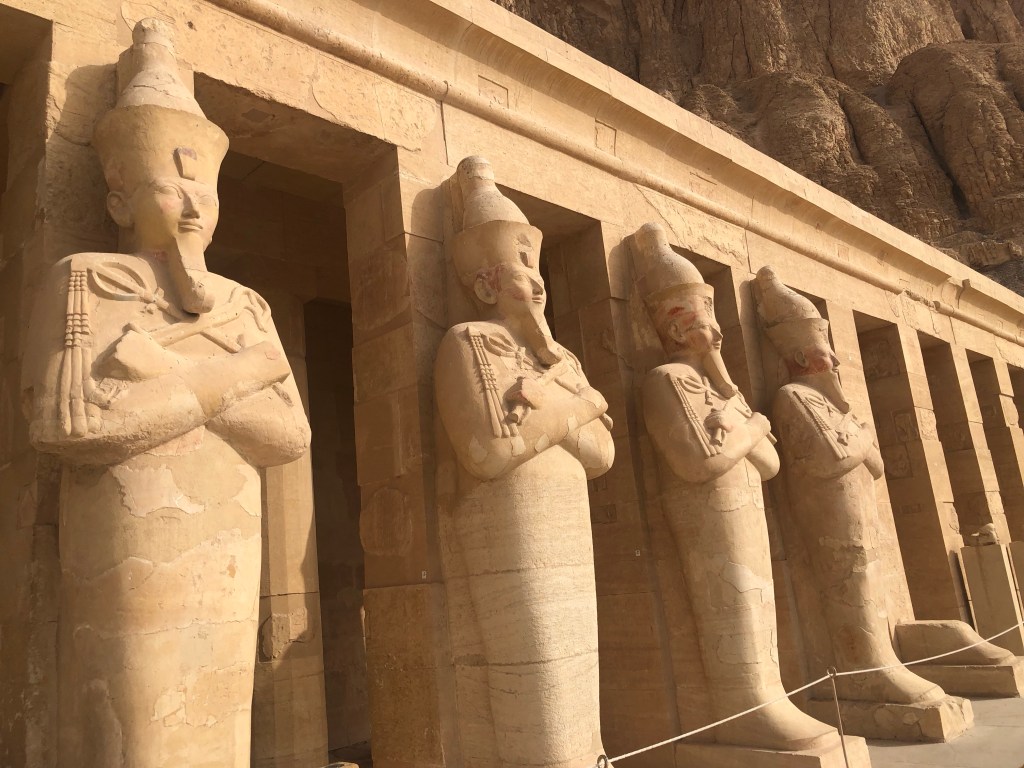
From the Karnak temple near Luxor, Egypt…
We try to work with the gods of our understanding…until we find the real thing….
June 11, 2023
Preached at Cooks Point on June 11, 2023.
FOCUS: We are standing on the promises of God, that when our hearts condemn us, God is greater than our hearts, and he knows everything.
CAN WE BELIEVE THE PROMISES OF GOD?
How can we believe the promises of God, especially when everything seems to be falling apart? What about those promises that God told us in Deuteronomy 31 and dozens of other passages? “I will never leave you, nor forsake you..” “For I know the plans I have for you, plans for hope and a future…”
What do we do with that on those days, in those times, in these years, when everything seems to be falling apart?
Can we look beyond our vision, trust beyond what we can see?
What does it take to do that?
Of course, it takes faith, the substance of things hoped for, the evidence of things unseen. (Hebrews 11:1) I’ll show you a tremendous example of faith in God in spite of the evidence — it’s from Habakkuk 3, starting at the 17th verse:
Though the fig tree should not blossom, nor fruit be on the vines, the produce of the olive fail and the fields yield no food, the flock be cut off from the fold and there be no herd in the stalls, yet I will rejoice in the Lord; I will take joy in the God of my salvation. God, the Lord, is my strength; he makes my feet like the deer’s; he makes me tread on my high places.
If we put our hopes on circumstances, we will be disappointed. If we are suffering and put our hopes on medical breakthroughs we can be devastated at a harsh diagnosis. But if we put our hope in God we can have a promise beyond what we see.
We serve a God who rose from the dead, and in the promise of the Resurrection we will trust in the Lord who will see us through.
Last week we spent time talking about John Wesley and his struggle with faith and finally the realization of love of God that swept over him one May night in 1738 on Aldersgate Street in London. Wesley worked so hard, was so diligent in seeking God and trying to do all the right things and he had no confidence in his faith; when he was tested he was terrified, and he wanted so much more.
He realized he did not have the trust, the faith, the assurance of God that even the women and children of the group that traveled with him on the voyage across the Atlantic. When the storms came, he was terrified; they were praying and singing.
It was a realization for Wesley, and an awakening of sorts.
Maybe we need to come to an awakening ourselves. Do you want more of God? Do you want a deeper relationship with your Creator? The first step can be admitting there must be more.
ROMANS 7
1-6 New Life in Christ — married to Christ
We’re resuming the sermon series going through the apostle Paul’s letter to the Romans. We are up to chapter 7, which contains one of the most famous accounts of a spiritual struggle in the Bible, certainly outside the Psalms.
Romans 6 strengthens the argument Paul has been building since the first chapter that we are under sin until we come to the salvation of Christ. What that can mean is the rebellion against God, first brought forth in the Garden of Eden and continuing throughout history, the rebellion rules us, and teaches us false narratives about what is worthy, what is good, what is fair. What’s fair is whatever will suit me best, whatever will do the most for me. Same thing with what is worthy, or what is good — it’s whatever is best for me, all a desperate sense to find self-worth and looking in the wrong place.
One of my mentors talked spending your life climbing over people to get higher on the ladder of success and then finding you’ve got the ladder on the wrong wall.
Being governed by sin, slaves to sin, selfishness, leads to death, Paul says. We work for sin, and the wages of sin is death. But there is another way, and that’s why we’re here.
So we’re going to go through Romans 7 together, a few verses at a time, and then let’s just see.
Here’s verses 1-6:
Or do you not know, brothers — for I am speaking to those who know the law — that the law is binding on a person only as long as he lives? For a married woman is bound by law to her husband while he lives, but if her husband dies she is released from the law of marriage. Accordingly, she will be called an adulteress if she lives with another man while her husband is alive. But if her husband dies, she is free from that law, and if she marries another man she is not an adulteress.
Likewise, my brothers, you also have died to the law through the body of Christ, so that you may belong to another, to him who has been raised from the dead, in order that we may bear fruit for God.
For while we were living in the flesh, our sinful passions, aroused by the law, were at work in our members to bear fruit for death. But now we are released from the law, having died to that which held us captive, so that we serve in the new way of the Spirit and not in the old way of the written code.
Paul is making the analogy that before we know Christ’s salvation we are under sin, bound like in a covenant that is only broken in death. He compares it to marriage, which is for life, at least that is how it is designed to be. We are freed from the power of sin only by death.
Paul means a spiritual death. Later in Galatians he writes that he no longer lives, but Christ lives in me — I have been crucified with Christ, Paul wrote in Galatians 2:20. Now that we have died to the law through the body of Christ we are changed, bound to him who has been raised from he dead that we might bear fruit for God.
In a real way, we are married to Christ.
Hard to believe? Hard to see? Hang in….
7-12 Internals, not externals. “covet”
Next, we’ll look at Romans 7-12 for his next argument:
What then shall we say? That the law is sin? By no means! Yet if it had not been for the law, I would not have known sin. For I would not have known what it is to covet if the law had not said, “You shall not covet.”
But sin, seizing an opportunity through the commandment, produced in me all kinds of covetousness. For apart from the law, sin lies dead.
I was once alive apart from the law, but when the commandment came, sin came alive and I died.
The very commandment that promised life proved to be death to me.
For sin, seeing an opportunity through the commandment, deceived me and through it killed me.
So the law is holy, and the commandment is holy and righteous and good.
Are you following the argument? I didn’t know I wasn’t supposed to do that until you told me I couldn’t! The law revealed the sin, not caused it.
Brenda and I were part of a large church in downtown Houston for a while, and the church had and still has a tremendous ministry to the homeless. One of the things the church provided was AIDS testing.
After testing, there would be many positive results, people who realized they had AIDS, and the newspapers would report that AIDS was on the rise. But it wasn’t — the reality was just now known.
Does that make sense?
The law tells us what sin is — idolatry, putting something or someone in the place of God in our lives. Most of the commandments given by God to Moses were pretty straight-forward — love the Lord your God, do not worship idols, do not murder, do not commit adultery, don’t lie or cheat — but at the end of the list we are told not to “covet” — to want something or someone that is not ours.
Coveting moves all the commandments from the exterior to the interior. Remember Jesus said it wasn’t enough not to murder, you weren’t to harbor anger. It wasn’t enough to not commit adultery, you are not to look on someone else with lust — you’re not to de-humanize them.
See, the law gives us an awakening, makes us realize something. And the process of dying to self and being united with God will continue in our lives.
Here’s where we get into the next part, where Paul really shows his honesty, and his vulnerability.
13-22 Current life, not former
Did that which is good, then, bring death to me? By no means! It was sin, producing death in me through what is good, in order that sin might be shown to be sin, and through the commandment might become sinful beyond measure.
For we know that the law is spiritual, but I am of the flesh, sold under sin.
For I do not understand my own actions. For I do not do what I want, but I do the very thing I hate.
Now if I do what I do not want, I agree with the law, that it is good.
So not it is no longer I who do it, but sin that dwells in me.
For I know that nothing good dwells in me, that is, in my flesh. For I have the desire to do what is right, but not the ability to carry it out.
For I do not do the good I want, but the evil I do not want is what I keep on doing.
Now if I do what I do not want, it is no longer I who do it, but sin that dwells within me.
So I find it to be a law that when I want to do right, evil lies close at hand.
We can be addicted to sin; we can be addicted to bad behavior. If any of you have struggled with an addiction and tried to give it up, you know how easy it is to go back in a weak moment to drink…. to smokes…to chocolate….to gossip…
But there can be a realization when you know you’re free.
Paul writes so honestly and vividly. We can relate! And just like the writer of Habakkuk and John Wesley’s journal Paul is facing the truth. We can’t change if we don’t admit something needs changing.
Now there has been a great deal of controversy over this passage. Some commentators believe that Paul is writing about his pre-Christian life, and that the struggles he is writing about are in the past.
However, many others believe he is writing about his present life in his struggle with sin. He is writing in the present tense, for instance. And, at least in my experience and perhaps in yours, believing that once we turn our lives to Jesus we won’t struggle any more doesn’t get us very far except further on the road of denial.
23-25 Admit we are wretched!
Here’s how he wraps us the chapter:
For I delight in the law of God, in my inner being, but I see in my members another law waging war against the law of my mind and making me captive to the law of sin that dwells in my members.
Wretched man that I am! Who will deliver me from this body of death?
Thanks be to God through Jesus Christ our Lord! So then, I myself serve the law of God with my mind, but with my flesh I serve the law of sin.
Paul is setting us up for one of the great promises of the Bible at the beginning of chapter 8: there is therefore now no condemnation for those who are in Christ Jesus. We will talk much more about this next week, God willing.
The 12 Steps of recovery start with admitting we are powerless over our addiction, and the 12 step speaks about the spiritual awakening. We are still addicts, but we have been set free.
How does this tie in with the beginning, with John Wesley and his struggle, with Habakkuk? We admit where we are! And by admitting where we are we begin to cling to the promises of Scripture:
I will never leave you nor forsake you.
1 Peter 1:13 — Therefore, preparing your minds for action, and being sober-minded, set your hope fully on the grace that will be brought to you at the revelation of Jesus Christ.
God is my refuge and strength, an ever-present help in trouble. Psalm 46: 1
…for whenever our hearts condemn us, God is greater than our hearts and he knows everything. 1 John 3:20.
Even when we don’t see it, we can trust in the Lord — because He loves us more than we can imagine. We can pray when we feel defeated. We can pray and trust when we can’t see a way out. Jesus carried the weight of sin for us. And in the Garden on the night he was betrayed, he asked that the burden be lifted from him. The late Tim Keller wrote that the cup could not be taken from Him — it was as if the Lord said that if I save you, you cannot save them. Jesus took it all for us on the Cross, and we can pray to the one who holds our life, and will be with us when we most need it.
We can stand on the promises of Christ our king…
In the name of the Father, and of the Son, and of the Holy Spirit.
Amen


 The Unforced Rhythms of Grace -- Frank Coats